Passenger

Team RideWyze Posted on 10 April 2026
If you've ever typed "how much does it cost to build an app like Uber" into Google at 11 PM while scribbling business ideas on a notepad, you're not alone. Thousands of entrepreneurs, taxi operators, and logistics startups ask this exact question every day — and most of the answers they find online are either outdated, vague, or written by someone trying to upsell them a $500,000 custom build they don't need.
This guide cuts through all of that. We'll give you real numbers, real breakdowns, and real alternatives — including why platforms like RideWyze are changing the game for startups and established operators who want to launch fast without burning their entire budget.
A ride-hailing app isn't a single app. It's actually an ecosystem of at least three interconnected apps and one backend dashboard working in harmony:
Each of these has its own feature set, its own design requirements, and its own development timeline. Most cost estimates you see online only quote the rider app — which is like quoting the price of a car door when you asked how much a car costs.
Before we get to the numbers, you need to understand what you're actually paying for. Here's what every serious ride-hailing app needs:
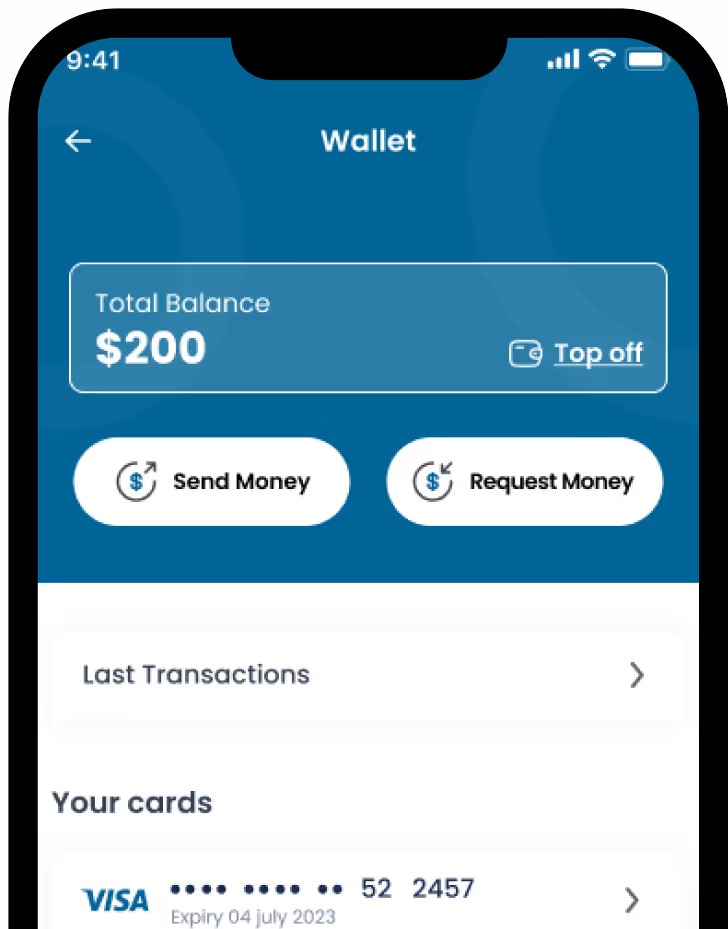
Rider App Features:
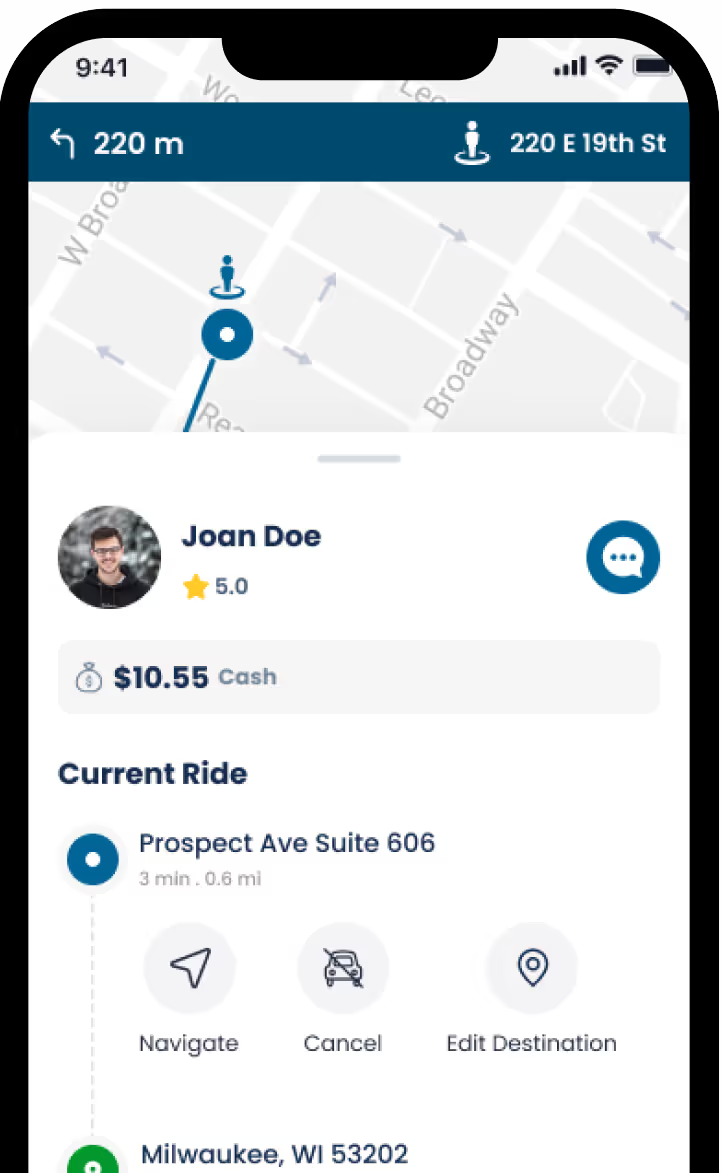
Driver App Features:
Admin Panel Features:
The more features you add, the more the cost climbs. Now let's talk actual numbers.
The cost of building a ride-hailing app depends on three main variables: your development approach, the team's location, and the complexity of features you need.
Understanding where money goes in a custom build helps you make smarter decisions about what to include in your MVP (Minimum Viable Product).
This is where most entrepreneurs get blindsided. The build cost is just the beginning. Here's what keeps the meter running after launch:
Ongoing server and infrastructure costs — AWS, Google Cloud, or Azure hosting for a moderate-scale ride-hailing app runs $500–$3,000/month depending on your user base. This scales rapidly as you grow.
Third-party API fees — Google Maps API alone can cost $200–$2,000/month at scale. Add Twilio for SMS/calls, Stripe or Braintree for payments, and Firebase for notifications, and your monthly API costs can easily reach $1,000–$5,000.
App store fees — Apple charges $99/year for developer accounts. Google charges $25 (one-time). But more importantly, both stores take a 15–30% commission on any in-app purchases.
Maintenance and updates — Budget at least 15–20% of your initial development cost annually for bug fixes, OS updates, and feature improvements.
Marketing and user acquisition — Building the app is step one. Getting your first 1,000 riders and 100 drivers is step two, and it costs money. Expect $5,000–$50,000+ in initial marketing spend.
Customer support infrastructure — Whether that's a support team, chatbot, or helpdesk software, this adds ongoing operational cost.
Here's the question every entrepreneur should ask before spending $80,000 on a custom build: Do I need to build this from scratch, or do I need a working, revenue-generating ride-hailing business?
If the answer is the latter, white-label platforms like RideWyze are the smarter move — by a significant margin.
RideWyze gives you everything you'd spend 12 months building, fully deployed and ready to launch in weeks. The rider app, driver app, admin dashboard, dispatch portal, real-time tracking, payment integration, surge pricing, analytics — it's all there, tested, and working. You get to focus on what actually grows your business: getting drivers on the road and riders in the app.
For entrepreneurs entering emerging markets, regional taxi operators looking to digitize, or startups testing product-market fit, this approach eliminates the biggest risk in app development: spending your entire budget before you've validated demand.
Use this simple framework to estimate your true budget:
Step 1 — Define your MVP scope. What's the minimum feature set you need to serve your first 500 customers? Don't build for 50,000 users on day one.
Step 2 — Choose your market. A city-level launch needs far less infrastructure than a national rollout. Start local, scale smart.
Step 3 — Choose your approach. Custom build if you have $50,000+ budget and 12+ months of runway. White-label if you want to be live in 30 days with $500–$2,000/month operational cost.
Step 4 — Budget for 18 months, not 6. Most ride-hailing startups that fail don't fail because the app was bad. They fail because they ran out of money before getting enough traction. Build a 12–18 month operational runway into your plan.
Step 5 — Factor in driver and rider acquisition. Your first 100 drivers won't find you. You'll need promotional incentives, local outreach, and marketing spend. Budget $10–$30 per acquired driver.
A custom-built Uber-like app typically costs between $30,000 and $300,000 depending on features, platform (iOS/Android), and the development team's location. A white-label solution like RideWyze can get you a fully functional equivalent for a fraction of that cost within weeks.
The most cost-effective approach is using a white-label ride-hailing platform. Instead of hiring a development team and spending months building from scratch, you get a ready-made, customizable solution that launches fast and costs a predictable monthly fee.
Custom development typically takes 8–18 months for a complete app ecosystem (rider app, driver app, admin panel). White-label platforms like RideWyze reduce this to 2–6 weeks from signup to launch.
Yes. A proper ride-hailing solution requires at minimum a rider-facing app, a driver-facing app, and an admin dashboard. These are three distinct products with different user flows, permission levels, and feature sets.
Most modern ride-hailing apps use React Native or Flutter for mobile (allowing iOS + Android from one codebase), Node.js or Python for the backend, Google Maps or Mapbox for mapping, Stripe or PayPal for payments, and Firebase or AWS for infrastructure.
Yes — particularly in emerging markets across Southeast Asia, Africa, the Middle East, and Latin America where digital mobility is still growing rapidly. The key is launching with low overhead (white-label platform) and focusing on hyperlocal market capture before scaling.
Ready to elevate your ride-hailing business? RideWyze has the tools and expertise to help you succeed. Contact us for a personalized demo today!

Create a free account and get full access to all features for 30 days.No credit card needed. Trusted by over 4,000 Clients.


from 200+ reviews

Start your 30-day free trial.