Passenger

Team RideWyze Posted on 11 August 2026
Every second of friction in a payment flow costs bookings. A passenger who has just arrived at their destination and needs to fumble for a card, find the right tap-to-pay confirmation, or — worst of all — search for cash, is a passenger who remembers that moment of inconvenience far more vividly than the seamless trip that preceded it. Payment is the final impression of every ride. Done well, it is invisible. Done poorly, it is the lasting memory that shapes whether that passenger books again.
The global transportation industry is in the midst of a payment revolution that is moving faster than most operators realize. <cite index="18-1">Over 90% of consumers have used some form of digital payment in the past year.</cite> <cite index="18-2">85% of Generation Z and 82% of millennials prefer contactless digital payments over cash — and the overall demand for cashless payments in taxis is projected to rise to 91% by 2028.</cite> <cite index="20-1">Over 50% of the global population now uses digital wallets, replacing traditional cards and cash, especially across Asia, Latin America, and Africa.</cite>
This is not a trend that ride-hailing operators can monitor from a distance and adopt eventually. The passengers who use digital wallets most — younger, urban, high-frequency ride-hailing users — are the most commercially valuable demographic in the industry. When their preferred payment method is not supported, they do not adapt to the platform. They find a platform that works the way they already pay.
<cite index="21-1">Digital wallets and mobile payment gateways help ride-hailing companies grow by enabling fast, reliable, and localized in-app payments across different regions. A strong payment gateway integration improves conversion rates, supports recurring billing like ride passes, and simplifies cross-border transactions. This flexibility allows platforms to expand into emerging markets where mobile wallet adoption and contactless payments are the preferred way to pay.</cite>
RideWyze builds payment flexibility into the platform's architecture from the ground up — supporting multiple digital wallets, cards, cash, and emerging payment methods through a configurable, market-specific payment integration layer. This blog maps the complete digital wallet landscape for ride-hailing operators: what wallet integration enables, which payment methods matter by region, how to configure them on RideWyze, and what the future of ride-hailing payments looks like.
The connection between payment method availability and booking conversion is direct and quantifiable. Every payment method a passenger prefers but cannot use is a booking that does not complete.
Consider the friction map of a booking that reaches the payment step but cannot complete because the passenger's preferred method is not supported:
The conversion loss at this stage is not hypothetical. <cite index="24-1">A slow or glitchy payment system leads to frustrated customers and drivers, potentially driving them away from the platform. Whether it's credit cards, digital wallets, or cryptocurrency, it's important to offer multiple options.</cite> For operators in markets where specific digital wallets dominate — GrabPay in Southeast Asia, M-Pesa in East Africa, Paytm in India, PIX in Brazil — failing to support the dominant method means being functionally unusable for the majority of the target passenger base.
Payment completeness matters on the supply side as well as the demand side. Drivers who receive earnings through their preferred method — whether that is instant wallet transfer, bank account payout, or in-app wallet accumulation — trust the platform more than those who face payment delays, unfamiliar transfer methods, or forced cash handling. <cite index="21-2">For drivers, cashless rides are valuable only if earnings arrive quickly. Platforms now offer account-to-account transfers, instant debit payouts, and wallet withdrawals, improving retention and trust within two-sided marketplaces.</cite>
RideWyze's configurable driver payout system allows operators to match earnings delivery to what drivers in their specific market trust and prefer — a direct contributor to driver retention that is as commercially important as passenger payment experience.
The markets with the highest ride-hailing growth potential — South Asia, Southeast Asia, Sub-Saharan Africa, and Latin America — are also the markets where digital wallet adoption is highest and bank account penetration is lowest. <cite index="21-3">Wallets opened doors to underbanked users — McKinsey estimates digital finance could add $3.7 trillion to emerging economies' GDP over the next decade by expanding access and fostering inclusive growth.</cite>
For ride-hailing operators entering these markets, supporting the locally dominant wallet is not a nice-to-have feature — it is the market entry requirement. A platform that only processes Visa and Mastercard is inaccessible to a significant portion of passengers in markets where digital wallets serve the unbanked population that traditional card networks do not reach.
Digital wallet usage is highly regional. The wallet that dominates in one market may be completely absent in another. RideWyze operators expanding across multiple markets need a payment architecture that adapts to local wallet ecosystems rather than imposing a single global payment stack.
Apple Pay and Google Pay represent the most frictionless payment experience available in ride-hailing today. Passengers authorize a payment with a fingerprint or face scan — no card entry, no PIN, no redirect. The transaction completes in under two seconds. For the operator, this near-zero-friction checkout is a direct conversion rate improvement at the payment confirmation step.
<cite index="17-1">The shift toward cashless transactions, supported by e-wallets and fintech solutions, accelerates digital adoption in ride-hailing.</cite> Apple Pay and Google Pay are the primary drivers of contactless payment adoption in North American and European markets, and their share of ride-hailing payment transactions is growing rapidly. RideWyze's payment gateway integration supports both natively.
GrabPay in Southeast Asia, GoPay in Indonesia, Paytm and PhonePe (UPI) in India, M-Pesa in East Africa — these are not supplementary payment methods in their respective markets. They are the primary payment infrastructure for hundreds of millions of users. <cite index="20-2">Super apps like WeChat Pay, GrabPay, Gojek, and Amazon Pay embed digital wallets into ecosystems for ride-hailing, e-commerce, delivery, and more. This integration increases customer stickiness by allowing users to pay across all services within a single platform.</cite>
For RideWyze operators in these markets, integrating the locally dominant wallet is equivalent to accepting cash in a cash-dominant market — it is the basic requirement for serving the passenger base, not an optional enhancement. RideWyze's API payment layer supports integration with regional wallet providers through standard payment gateway APIs, allowing operators to connect the wallets their specific market uses.
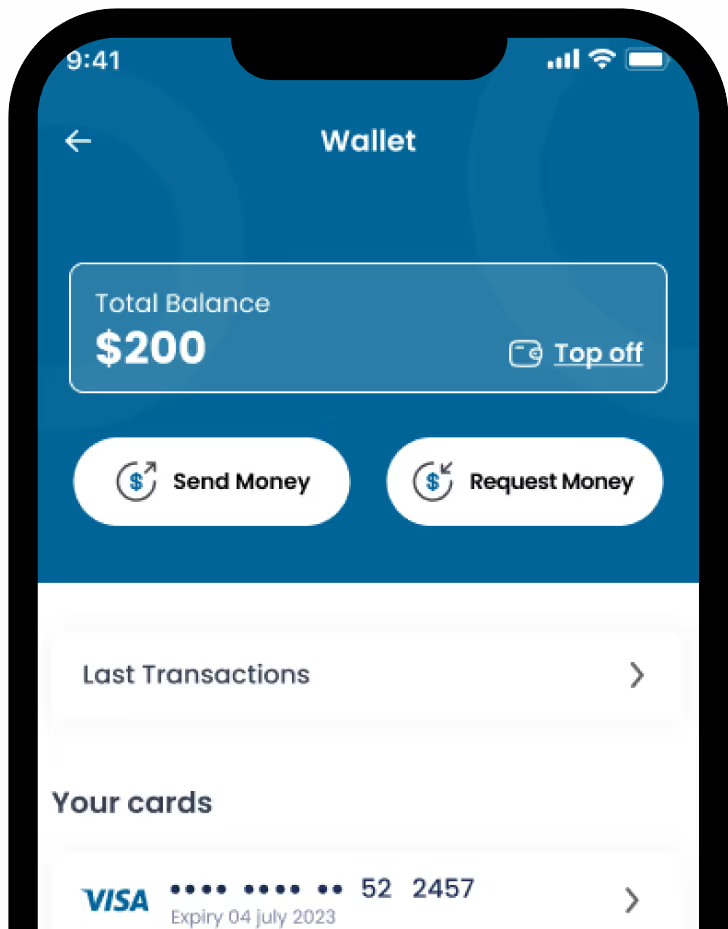
The in-app wallet — where passengers pre-load credit into their ride-hailing account and bookings are deducted automatically — creates a payment experience that is even more seamless than external wallet integration. Once loaded, in-app wallet payments require zero confirmation steps. The booking completes, the fare is deducted, and the passenger exits the vehicle without any payment interaction at all.
Beyond convenience, the in-app wallet creates powerful commercial dynamics:
Pre-committed spend — passengers who load credit into the in-app wallet have pre-committed that money to the platform. They are less likely to evaluate competitors for their next booking because switching platforms would mean abandoning a balance.
Promotional incentives — operators can run "load $50, get $10 bonus credit" campaigns that drive wallet top-ups, pre-committing larger passenger balances and generating immediate cash flow for the operator.
Subscription integration — weekly or monthly ride pass subscriptions deduct from the in-app wallet automatically, creating the recurring revenue model that improves both operator cash flow predictability and passenger retention.
RideWyze's in-app wallet is configurable by operators — including minimum top-up amounts, bonus credit rules, promotional loading incentives, and auto-reload thresholds that keep passengers' wallets funded without manual action.
Account-to-account (A2A) payment integration — where passengers pay directly from their bank account to the operator rather than through a card network intermediary — is growing rapidly in markets with instant payment infrastructure. Brazil's PIX, India's UPI, and the UK's Faster Payments all enable instant bank transfers at zero or near-zero transaction cost.
<cite index="18-3">41% of consumers interested in pay-by-bank options would like to use this method for ridesharing services, highlighting a growing preference for this payment form in the transportation industry.</cite> For operators, A2A payments offer a significant cost advantage over card processing — eliminating the 1.5–3% interchange fee that card networks charge, directly improving per-trip margin.
Cash is not a legacy payment method that operators should be ashamed of supporting — it is a necessary inclusion in markets where digital payment infrastructure is still developing, where specific passenger demographics (elderly, unbanked) rely on cash, or where regulatory frameworks require cash acceptance as a transport accessibility standard.
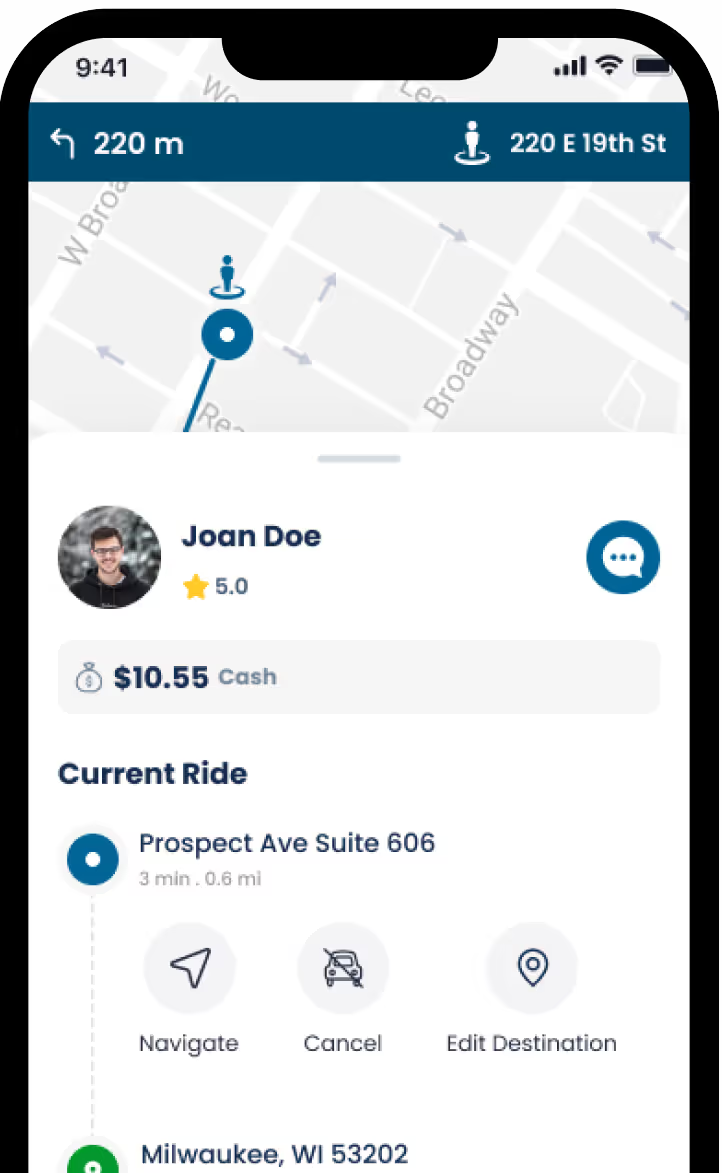
RideWyze supports configurable cash payment options that operators can activate or deactivate by market, zone, or vehicle category. An operator running premium vehicles in a Gulf city might disable cash entirely. The same operator running economy rides in a peri-urban area of their market might configure cash as the default for that category. The platform adapts to the market reality rather than imposing a one-size-fits-all payment policy.
The driver experience for cash trips includes an in-app cash collection confirmation step — the driver marks the trip as cash-settled before it closes, ensuring accurate accounting in the operator's financial reporting regardless of payment method.
<cite index="22-1">Platforms like RideWyze are exploring the potential of accepting digital currencies like Bitcoin, Ethereum, and others as alternative payment options. Transactions made with cryptocurrencies are typically faster, have lower fees, and are more secure due to the blockchain technology that underpins them.</cite>
Cryptocurrency payment for ride-hailing is still in its early stages — more relevant in specific markets and for specific passenger demographics than as a mainstream payment option. However, for operators building platforms for tech-forward, crypto-native user segments or operating in markets with significant crypto adoption (El Salvador, parts of Southeast Asia), cryptocurrency payment readiness is a differentiation opportunity that RideWyze's API architecture is positioned to support.
RideWyze's payment integration model works through a gateway layer — operators connect to their preferred payment processor(s) through the RideWyze API, and that processor handles the specific wallets, cards, and payment methods relevant to their market. This architecture means:
From the passenger perspective, the payment configuration is invisible. They see a payment method selection screen during onboarding where they add their preferred methods. Subsequent bookings charge automatically without requiring payment re-selection. The experience is as seamless as any consumer app — the complexity of multi-gateway integration is entirely behind the scenes.
The driver-side payment system is configurable independently from the passenger-side payment integration. Operators can distribute driver earnings through:
The ability to deliver driver earnings through methods that drivers in specific markets trust — particularly mobile money in Africa and digital wallets in South Asia — directly supports driver retention in exactly the markets where competition for driver supply is most intense.
Payment security in ride-hailing is non-negotiable. RideWyze's payment architecture operates within PCI DSS compliance standards — card data is handled by the payment processor, never stored on RideWyze's servers. Tokenization ensures that passenger payment details are never exposed in the event of a platform security incident. Multi-factor authentication for payment method changes adds a protective layer against unauthorized account access.
The most forward-looking aspect of digital wallet integration in ride-hailing is what it enables beyond simple transaction processing. <cite index="21-4">Many companies provide micro-loans, fuel cards, and insurance within their driver payment systems, illustrating embedded payments in action. The ride app becomes a financial hub, advancing financial inclusion for gig workers who lacked banking access.</cite>
For RideWyze operators, the in-app wallet is not just a payment convenience — it is the foundation for a set of embedded financial services that deepen the platform's value for both drivers and passengers:
Driver financial services — income advance against earned but not yet paid earnings, fuel card linked to in-app earnings that automatically reloads from driver balance, vehicle insurance premium deducted from earnings, and maintenance savings account with automatic allocation from each completed trip.
Passenger loyalty and subscription — in-app wallet credit earned through loyalty programs, ride pass subscriptions auto-renewing from wallet balance, and referral rewards paid as wallet credit rather than cash (which keeps the value within the platform ecosystem).
Corporate account integration — company-funded in-app wallets for employee ride budgets, spend limit enforcement at the payment level, and automated monthly expense reconciliation fed from ride transaction data.
Each of these embedded finance applications requires the in-app wallet as infrastructure. Operators who build the wallet integration early create the foundation for a progressively richer financial services layer that increases the platform's value proposition for every stakeholder — passengers, drivers, and corporate clients simultaneously.
<cite index="25-1">Industry experts analyzing ride-hailing platforms globally confirm that 2026 is the year more ride-hailing apps expand into mobility super-apps — with cashless payment options as one of the core drivers. Users want convenience where diverse mobility solutions, proactive safety functions, and seamless digital payments can all be found in one platform.</cite>
Digital wallet integration is not just a payment feature — it is the connective tissue of a multi-service platform. <cite index="20-3">Wallets evolved into full financial hubs offering subscription management, utility bill payments, and recurring billing features.</cite> When an operator's ride-hailing wallet is also the wallet that passengers use to pay for food delivery, package courier, and premium transport services, the wallet itself becomes a retention mechanism — passengers who have a funded wallet in your platform have a financial incentive to use all the services on it.
For RideWyze operators building toward a multi-service platform (as described in the multi-service app blog earlier in this series), the digital wallet is the financial layer that makes the multi-service experience seamless. One top-up funds all services. One transaction history covers all orders. One loyalty program rewards activity across all categories. This financial integration is what transforms a collection of services into a platform that passengers genuinely depend on.
<cite index="21-5">The future of in-app payments in ride-hailing platforms is moving toward invisible and embedded payments, where transactions happen automatically in the background. Innovations such as AI-powered payment selection, biometric authentication, cryptocurrency options, and super-app ecosystems will make mobile payments even more seamless.</cite>
AI-powered payment selection — the platform automatically selects the optimal payment method for each transaction based on the passenger's balance, preferred method, and the transaction amount — without requiring any passenger decision.
Biometric payment authorization — face recognition and fingerprint confirmation replacing PIN and password authentication for payment changes, reducing fraud while improving the authorization experience.
Subscription and pass-based billing — recurring ride subscriptions that auto-renew from in-app wallet balances, creating predictable revenue for operators and cost certainty for frequent passengers.
Cross-border wallet compatibility — <cite index="21-6">travelers expect their home wallet to work abroad. Modern platforms support cross-border mobile payments, dynamic currency conversion, and localized tax rules, transforming a ride app into a global companion.</cite> For operators serving tourist-heavy markets or expanding across borders, cross-border wallet support is an increasingly important competitive feature.
Embedded financial products — income advance, fuel cards, and insurance embedded directly into the driver payment experience, transforming the platform from a ride-hailing operator into a financial services provider for gig workers.
Each of these developments requires the same foundation: a flexible, API-connected, multi-method payment architecture. RideWyze is built for exactly that — giving operators the payment infrastructure that supports where payments are today and where they are heading.
Payment is the moment where every ride either ends perfectly or leaves a lasting frustration. Digital wallet integration — done well, covering the methods passengers in your market actually use — is one of the highest-ROI investments a ride-hailing operator can make. It improves conversion at the booking stage, reduces post-trip friction, increases driver trust and retention, and builds the financial infrastructure for the embedded finance and super-app services that will define the next phase of the industry.
RideWyze's configurable, API-connected payment architecture supports the full spectrum of payment methods your passengers and drivers need — from Apple Pay and GrabPay to M-Pesa and UPI, from card processing to in-app wallets to cash. Start your 30-day free trial at ridewyze.com — no credit card required, full platform access from day one.
RideWyze's payment architecture is designed for flexibility — operators connect their preferred payment gateways through the API layer, which supports integration with any wallet or payment method available through major payment processors. This includes Apple Pay, Google Pay, regional super-app wallets (GrabPay, GoPay, Paytm), mobile money platforms (M-Pesa, MTN Mobile Money), instant bank transfer systems (UPI, PIX), and standard card processing. The specific wallets available depend on the payment processor the operator connects in their market.
85% of Generation Z and 82% of millennials prefer contactless digital payments over cash. Demand for cashless payments in taxis is projected to reach 91% by 2028. When passengers cannot pay with their preferred method, they do not adapt to the platform — they find one that works how they already pay. Supporting multiple methods, including the locally dominant digital wallet in each market, is a direct conversion rate and retention driver.
The in-app wallet creates a frictionless payment experience where bookings are settled automatically from a pre-loaded balance without any confirmation step. For passengers, this is the fastest possible checkout experience. For operators, it creates pre-committed spend (passengers who load the wallet have financially committed to the platform), enables promotional bonus credit campaigns that drive top-ups and lock in spend, and provides the infrastructure for ride pass subscriptions and loyalty programs.
RideWyze's driver payout system is configurable by operators to match what drivers in their specific market trust and prefer. Options include in-app wallet accumulation with on-demand withdrawal, direct bank transfer (daily, weekly, or per-ride), mobile money transfer (M-Pesa, GoPay, and others for unbanked drivers), and instant debit card payouts in markets where this is available. Matching driver payout to local preferences directly supports driver trust and retention.
Yes. RideWyze's cash payment configuration allows operators to enable cash as a payment option by market, zone, or vehicle category. This is essential for operators in markets where digital payment adoption is still developing, or where specific passenger demographics (elderly passengers, unbanked populations) rely on cash. Operators who serve both digital-first urban passengers and cash-reliant suburban or rural passengers can configure the appropriate payment mix for each zone independently.
RideWyze's payment architecture operates within PCI DSS compliance standards — card data is handled by the payment processor and never stored on RideWyze's servers. Tokenization protects passenger payment details from exposure in the event of any platform security incident. Multi-factor authentication for payment method changes adds protection against unauthorized account access.
Ready to elevate your ride-hailing business? RideWyze has the tools and expertise to help you succeed. Contact us for a personalized demo today!

Create a free account and get full access to all features for 30 days.No credit card needed. Trusted by over 4,000 Clients.


from 200+ reviews

Start your 30-day free trial.