Passenger

Team RideWyze Posted on 27 February 2026
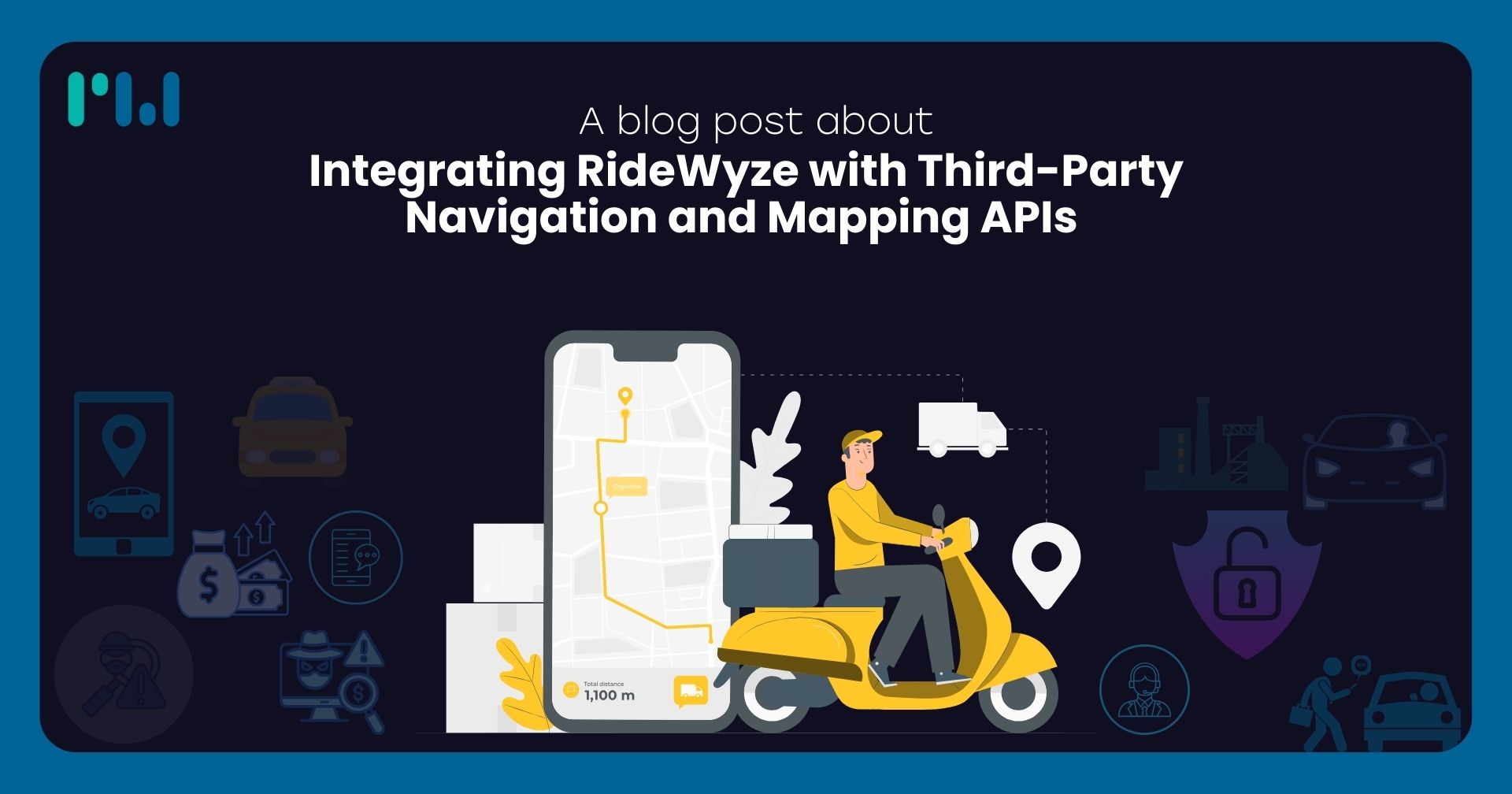
RideWyze, launched in 2017 in Baltimore, Maryland with $2.5 million in seed funding, has matured into a modern mobility platform designed around RideWyze API integration principles. The platform connects passenger applications, driver tools, and dispatcher dashboards through a unified RideWyze navigation API that supports real-time GPS tracking, secure payments, and intelligent dispatch logic.
From a developer’s perspective, the RideWyze developer API acts as the central nervous system of a ride-hailing product. Without mapping intelligence, even the most elegant booking interface would feel blind. By linking the platform with Google Maps Platform, Mapbox, and HERE Maps, engineers can implement distance matrix API calls, geocoding services, turn-by-turn navigation SDKs, and WebSocket live tracking inside a single workflow.
Think of RideWyze as the brain and third-party maps as the senses. The integration allows the system to “see” roads, “feel” traffic, and “predict” arrival times. This is why queries such as “how to integrate RideWyze API step by step” and “RideWyze Google Maps integration cost” are increasingly common among startups and fleet operators.
The global ride-hailing market is expected to expand from $130–$191 billion in 2024 to between $381–$590 billion by 2032/33, growing at up to 17.4% CAGR. In this environment, every platform competing with Uber or Bolt must treat RideWyze platform integration as a strategic asset rather than a simple add-on.
Regional dynamics reinforce this need. Asia-Pacific controls 38.91% of the market, where dense megacities demand advanced geofencing boundaries and offline resilience. South America, growing at 16.65% CAGR, requires battery-efficient navigation due to mid-range devices. These realities push architects toward features like predictive ETA algorithms, route optimization engines, and map tile caching.
Investors and operators evaluate platforms by how well they handle real-time GPS tracking API performance, surge pricing logic, and driver matching algorithms. As a result, RideWyze third-party API connectivity has become a core buying criterion for enterprise fleets, paratransit services, and last-mile delivery providers.
Each provider brings a distinct personality to RideWyze navigation API design:
These metrics shape the popular RideWyze multi-provider routing strategy, where search, navigation, and fleet analytics are split across vendors to balance cost and reliability.
A typical REST API ride-hailing sequence inside RideWyze looks like this:
This event-driven loop repeats every few seconds, creating the familiar moving car icon riders trust.
Using OSRM, Valhalla, or commercial providers, RideWyze can perform multi-stop route planning and waypoint optimization. For airport transfers or corporate transportation, this directly improves unit economics and addresses searches like “RideWyze route optimization algorithm integration.”
ETA accuracy depends on historical speed data, traffic data integration, and map matching snap-to-road. Google’s Routes API tiers ($5–$15 per 1K) demonstrate how precision becomes a budgeted capability rather than guesswork.
Embedding navigation within the RideWyze driver app eliminates context switching. Mapbox’s efficient memory footprint (45MB vs Google 52MB) reduces device heating and keeps drivers focused.
A robust RideWyze SDK integration typically includes:
This mirrors best practices searched as “RideWyze microservices architecture design.”
Security layers—OAuth 2.0 authentication, JWT token security, API key management—prevent abuse of expensive mapping endpoints and support enterprise SSO.
Using serverless functions (Lambda), circuit breaker patterns, and rate limiting strategies, the platform handles traffic spikes during concerts or storms.
Providers differ in GeoJSON, WGS84, polyline encoding; normalization ensures consistent fare calculation, surge pricing API, and driver earnings API.
Developers enable:
/routes → distance matrix API/eta → predictive ETA algorithms/geofence → geofencing boundariesThe RideWyze sandbox environment setup validates quotas and answers queries like “RideWyze API rate limiting best practices.”
Platform build ranges:
Navigation features:
Ongoing usage—Google $2–$30/1K—makes cost control and caching essential.
Common hurdles include:
Mature operators adopt:
This directly supports “RideWyze fallback navigation provider setup.”
Governance requires:
Emerging directions:
RideWyze API integration elevates a booking tool into an intelligent mobility platform. With the market approaching $590B, success depends on blending RideWyze Google Maps integration, Mapbox performance, and HERE enterprise features inside a secure microservices framework.
Teams that master real-time GPS tracking API, distance matrix batching, WebSocket live tracking, and route optimization engines will build resilient platforms ready for the next decade of connected transportation.
The best approach for integrating RideWyze with third-party navigation and mapping APIs is to adopt a structured, multi-layer architecture that separates mapping logic from core ride-hailing operations. Developers should first connect the RideWyze navigation API with a primary provider such as Google Maps or Mapbox for geocoding and route calculation, then add fallback providers like HERE for offline or enterprise use cases. This approach to integrating RideWyze with third-party navigation ensures higher availability, better ETA accuracy, and reduced vendor dependency. Using WebSocket live tracking alongside the distance matrix API further improves real-time location updates and driver positioning.
RideWyze Google Maps integration cost depends on both development effort and ongoing API usage. On the development side, integrating core features such as real-time GPS tracking, turn-by-turn navigation, and geofencing typically ranges from $5,000 to $25,000. The operational RideWyze Google Maps integration cost is driven by request volume, with Google charging roughly $2–$30 per 1,000 requests depending on the service tier. Fleets can lower the RideWyze Google Maps integration cost by caching map tiles, batching distance matrix calls, and adopting a hybrid strategy that uses Mapbox for driver navigation while reserving Google for Places search.
Yes, RideWyze API integration can fully support multi-provider routing strategies, and many enterprise fleets already use this model. Through RideWyze API integration, platforms can combine Google Maps for location search, Mapbox for low-latency driver navigation, and HERE for offline fleet analytics. This multi-provider RideWyze API integration improves resilience because if one service reaches rate limits, the system automatically switches to another. It also allows businesses to choose the most cost-efficient provider for each function instead of relying on a single expensive API.
A secure RideWyze navigation API implementation requires several layers of protection. OAuth 2.0 authentication and JWT token security are essential to prevent unauthorized access to the RideWyze navigation API. Rate limiting, API gateway architecture, and encrypted WebSocket channels protect sensitive trip data during transmission. In addition, a proper RideWyze navigation API implementation must follow GDPR and CCPA rules, including user consent for location tracking, data anonymization, and clear retention policies.
Real-time GPS tracking in RideWyze third-party API connections works through continuous location streaming between the driver app and backend servers. The RideWyze third-party API receives coordinates from the mobile SDK, processes them with map-matching algorithms, and updates the passenger interface via WebSockets. This method of real-time GPS tracking in RideWyze third-party API setups enables accurate ETAs, live vehicle movement, and automated rerouting when traffic conditions change.
The common challenges in RideWyze platform integration with mapping services include high API costs, battery drain, and inconsistent data formats between providers. During RideWyze platform integration, developers often face latency spikes when distance matrix requests are not batched correctly. Another challenge in RideWyze platform integration is maintaining accurate ETAs across different regions with varying traffic data quality. These issues can be solved through caching strategies, edge computing, and a hybrid provider model that balances performance and price.
Ready to elevate your ride-hailing business? RideWyze has the tools and expertise to help you succeed. Contact us for a personalized demo today!

Create a free account and get full access to all features for 30 days.No credit card needed. Trusted by over 4,000 Clients.


from 200+ reviews

Start your 30-day free trial.