Passenger

Team RideWyze Posted on 18 August 2026
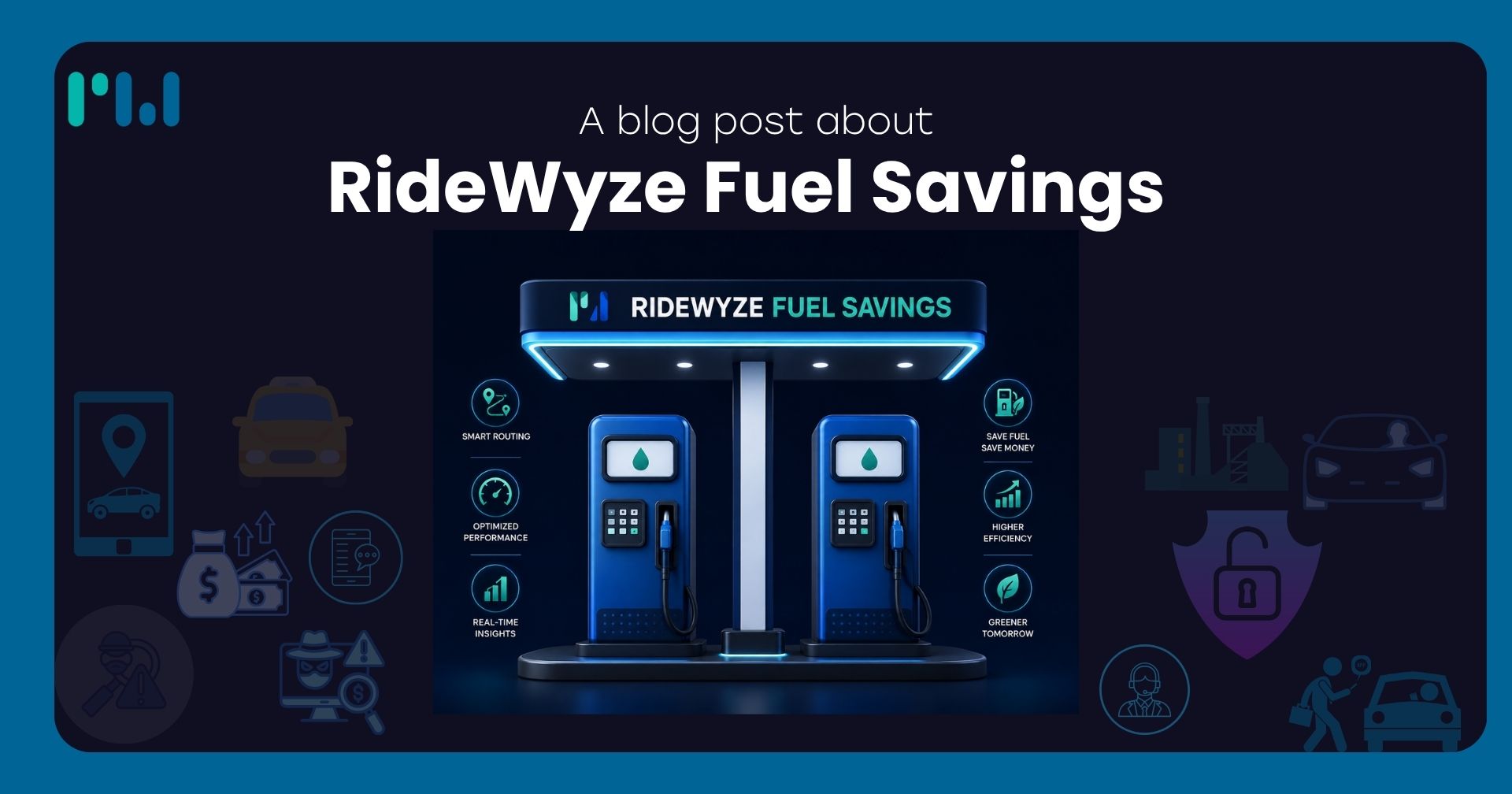
Fuel is the largest single variable cost in a ride-hailing driver's working life. Every kilometre driven, every minute spent idling at a traffic light, every unnecessary detour through a congested district, every empty repositioning drive between drop-off and the next pickup — all of it comes out of the driver's pocket before a single rupee, rand, dollar, or dirham reaches their earnings. In a profession where margins are already thin, fuel cost management is not an operational detail. It is the difference between a financially viable working day and one that barely breaks even.
<cite index="50-1">Route optimization can significantly lower fuel costs by 20%, and the U.S. Department of Energy estimates that an idling vehicle consumes up to one gallon of fuel per hour.</cite> For a driver who idles for two hours across a full shift — not unusual in congested urban environments — that is two gallons of fuel generating zero income. Multiply that across a 300-day working year and the cumulative cost is significant.
<cite index="51-1">Fuel cost fluctuations are one of the primary drivers shaping operator strategy in the ride-hailing market.</cite> With Brent crude prices remaining elevated due to ongoing geopolitical pressure in 2025–2026, and with fuel representing approximately 21% of total per-mile vehicle operating costs across commercial fleets, the operators and drivers who actively manage fuel consumption have a structural cost advantage over those who treat it as a fixed background expense.
RideWyze addresses driver fuel costs through every mechanism available: AI route optimization that eliminates unnecessary kilometres, smart dispatch that reduces deadhead and idle mileage, demand heatmaps that position drivers efficiently before their next booking, and EV fleet integration that eliminates fuel costs entirely for operators making the transition to electric. This blog maps each mechanism in detail — the fuel cost problem it solves, the data behind the improvement, and how drivers and operators access it through the RideWyze platform.
To understand where RideWyze saves fuel costs, it helps to break down exactly where fuel is consumed in a typical ride-hailing driver's shift. Not all kilometres are equal — some generate income, others generate only cost.
Revenue kilometres — the distance driven with a passenger in the vehicle from pickup to drop-off. This is the only portion of a driver's mileage that directly generates income. These cannot be eliminated — they are the service.
Deadhead kilometres — the distance driven without a passenger, from the previous drop-off to the next pickup location. This is pure cost: fuel burned, vehicle wear accumulated, and time spent with no income being generated. Research shows deadheading accounts for approximately 40% of total ride-hailing mileage in unoptimized fleets.
Repositioning kilometres — the distance driven to reach a high-demand zone where the driver expects to find a booking. In platforms without demand forecasting, this is speculative — the driver moves toward where they think demand will be. In platforms with AI demand intelligence, this movement is guided by data.
Idle time fuel — fuel consumed while the engine is running but the vehicle is stationary: waiting at a pickup point, sitting in traffic, waiting in a queue for a booking. At the U.S. Department of Energy's estimate of up to one gallon per hour of idling, a driver idling for 90 minutes per shift consumes a meaningful fuel cost with no compensation.
RideWyze's fuel-saving mechanisms target each of these categories specifically — and the combined impact across an 8-hour shift is substantial.
The most consistent fuel saving RideWyze delivers is at the trip level: AI-powered route optimization that finds the most fuel-efficient path for every journey, not just the fastest one.
<cite index="49-1">Modern ride-hailing software leverages GPS tracking and real-time traffic insights to identify the fastest and most fuel-efficient routes for drivers. Through the driver app, drivers receive optimized navigation instructions that help them avoid traffic congestion, roadblocks, and unnecessary detours, ultimately improving overall ride efficiency.</cite>
The distinction between "fastest route" and "most fuel-efficient route" matters more than most operators realize. A route that is 2 minutes faster but involves stop-start traffic through a congested district burns significantly more fuel than a slightly longer route on a free-flowing road. Modern route optimization engines account for:
The cumulative effect across a full shift is significant. <cite index="50-2">Route optimization reduces fuel costs by 20% on average across commercial fleets.</cite> For a ride-hailing driver spending the equivalent of $20 daily on fuel at current prices, a consistent 20% reduction represents $4 per day — $1,200 per year — recovered directly as net income with no change to working hours or trip volume.
<cite index="52-1">Carriers ran 16.7% of total miles empty in 2024 — a capacity drain that smarter routing directly reduces.</cite> In ride-hailing, deadhead mileage consistently runs higher — 30 to 40% of total mileage in unoptimized operations — because passenger trips are shorter on average than cargo routes and drivers frequently need to reposition between drop-offs and pickups.
RideWyze's automated dispatch engine addresses deadheading at its source by optimizing the match between a completing trip's drop-off location and the next available booking's pickup location. Rather than simply assigning the nearest driver to each new booking independently, the dispatch engine considers the entire picture:
This optimization — running in milliseconds across every active driver in the fleet — means drivers receive their next booking assignment at the point where accepting it generates the minimum empty-driving distance. Over the course of a shift, the difference between reactive nearest-driver dispatch and this optimized multi-trip assignment is typically 20–30% fewer deadhead kilometres — a direct fuel cost reduction with no impact on service levels.
The practical calculation:A driver completing 20 trips per shift in an unoptimized fleet averages 3.5 km deadhead per trip = 70 deadhead km per shift.With RideWyze's optimized dispatch: average deadhead reduces to 2.1 km per trip = 42 km per shift.Reduction: 28 km per shift. At average fuel consumption of 10L/100km and a fuel price of $1.20/L, this saves approximately $3.36 per shift — $1,000+ per driver per year in direct fuel savings, captured entirely as additional net income.
One of the most fuel-costly behaviors in ride-hailing driving is speculative repositioning: a driver finishes a trip in a quiet area and drives toward where they guess demand will be next, burning fuel on a journey that may not result in a quick booking if the guess is wrong.
RideWyze's driver app displays a real-time demand heatmap — a visual overlay showing current and predicted demand intensity across all service zones. Drivers can see at a glance where bookings are being generated right now and where demand is forecast to be highest in the next 15–30 minutes.
This visibility transforms repositioning from a costly guess into a data-informed decision. Rather than driving 5 km toward the city center because it "usually" has demand at this time, the driver can see that demand is currently concentrated 2 km away in the business district and move there instead — burning less than half the repositioning fuel for a faster booking assignment.
The fuel saving from eliminating unnecessary repositioning is difficult to quantify precisely because it varies by driver behavior and market geography, but demand-guided repositioning consistently reduces the distance driven between drop-off and next booking by 20–35% compared to unguided driver positioning.
<cite index="50-3">The U.S. Department of Energy estimates that an idling vehicle consumes up to one gallon of fuel per hour.</cite> For ride-hailing drivers, idle time accumulates in three specific situations:
RideWyze's AI dispatch directly reduces idle wait time at pickup points by improving matching accuracy. When the dispatch engine consistently matches the closest available driver to each booking, pickup wait times drop — and the period a driver sits with the engine running at a pickup point compresses accordingly.
The demand heatmap and zone guidance tools reduce between-trip idling by directing drivers to zones where the next booking is most likely to come quickly — reducing the time between drop-off and next pickup that drivers spend sitting idle.
For drivers making 20 trips per shift with an average 4-minute wait at each pickup in an unoptimized system, reducing that average wait to 2.5 minutes saves 30 minutes of idle time per shift — at the U.S. DOE's estimate, that is roughly 0.5 gallons of fuel per shift saved from idle time reduction alone.
Fuel consumption is not just a function of where a driver goes — it is also a function of how they drive. Aggressive acceleration, hard braking, and high-speed cruising all consume meaningfully more fuel than smooth, steady driving on identical routes.
Research from peer-reviewed studies confirms that ride-hailing passengers give lower ratings to trips with harsh braking and rapid acceleration — meaning aggressive driving harms both fuel efficiency and driver ratings simultaneously.
RideWyze's driver performance scoring system — connected to telematics data from IoT-integrated vehicles — tracks and scores driving behavior including:
Drivers who can see their own eco-driving scores in the driver app have a clear, data-backed feedback signal that helps them improve their driving behavior — reducing fuel consumption while also improving passenger comfort and their own rating.
The fuel efficiency gain from smooth eco-driving compared to aggressive driving is consistently measured at 15–25% on identical routes. For a driver spending $20 daily on fuel, smooth driving alone saves $3–5 per shift. Combined with the route optimization savings above, the total daily fuel cost reduction from RideWyze's full suite of tools is typically $7–10 per driver per shift.
For operators making the transition to electric vehicle fleets, RideWyze's EV integration tools eliminate fuel costs at the source rather than just reducing them.
<cite index="53-1">Battery electric vehicles witness gradual adoption as charging infrastructure expands. Lower maintenance requirements and regulatory incentives encourage fleet transition.</cite> For drivers, the switch from petrol or diesel to an EV eliminates fuel cost entirely and replaces it with a significantly lower electricity cost — typically 60–75% cheaper per kilometre than equivalent petrol costs.
RideWyze's EV fleet management tools maximize the financial advantage of the EV transition:
Range-aware dispatch — drivers are not assigned trips that would leave their battery range insufficient for the return journey to a charging station, preventing stranded vehicles and ensuring every shift ends productively.
Charging window optimization — the demand forecasting system identifies natural demand lulls and coordinates EV charging to occur during these windows rather than at peak demand times, maximizing the percentage of each shift that the driver spends earning rather than charging.
Battery health monitoring — early identification of battery degradation that would reduce effective range, allowing proactive maintenance before range loss becomes an operational problem.
Charging cost optimization — for drivers with configurable charging schedules, EV management tools can identify off-peak electricity tariff windows for overnight charging, reducing the per-kilometre electricity cost below its already-low baseline.
Fuel savings are not an abstract operational metric for drivers — they are direct additions to net earnings. Every litre of fuel saved is money that stays in the driver's pocket. Over the scale of a full working year, the cumulative impact is significant.
These figures use conservative estimates — actual savings vary by market fuel price, vehicle fuel efficiency, and driver shift length. In higher fuel-cost markets like Europe or Southeast Asian island markets, the daily and annual savings are proportionally larger. In markets where CNG or LPG is used instead of petrol, the per-unit cost is lower but the optimization savings percentage remains consistent.
For operators who own or manage vehicles in their fleet — rather than using driver-owned vehicles — fuel cost savings translate directly into fleet operating economics, not just driver earnings. The same RideWyze tools that save individual driver fuel costs generate fleet-level efficiencies:
Fleet utilization rate improvement — optimized dispatch increases the percentage of active vehicle time that is revenue-generating rather than deadhead. A fleet with 70% utilization burns more fuel per revenue km than one with 85% utilization, because the idle and deadhead portion consumes fuel without compensation.
Predictive maintenance through IoT integration — vehicles with developing engine issues often consume more fuel before the problem manifests as a breakdown. RideWyze's IoT integration alerts operators to engine performance anomalies that include irregular fuel consumption patterns — allowing maintenance before the fault worsens and before the driver or operator absorbs months of elevated fuel costs from a sub-optimal engine.
EV charging cost management — for EV fleets, the electricity equivalent of fuel management — scheduling charging at off-peak tariff rates, coordinating charging windows with demand forecasting, and monitoring battery degradation that reduces range efficiency — is managed through RideWyze's EV fleet tools, keeping the per-km energy cost as low as possible across the fleet's operational life.
The platform tools do most of the optimization automatically, but drivers who actively engage with RideWyze's features maximize their fuel savings. The highest-impact actions drivers can take:
Follow the demand heatmap between trips — rather than defaulting to the city center between bookings, check the driver app's demand heatmap and position toward the zone showing the strongest upcoming demand. This reduces both repositioning distance and the time between bookings — saving fuel and increasing earnings per shift simultaneously.
Check eco-driving scores regularly — the driver performance dashboard shows behavior scores including braking and acceleration patterns. Drivers who review these scores and consciously adjust their driving toward smoother acceleration and earlier braking consistently see both fuel savings and rating improvements within two to three weeks.
Accept back-to-back booking assignments — when the dispatch system offers a next-trip assignment near the current drop-off point, accepting it immediately captures the low-deadhead assignment before a more distant pickup arrives for that booking. Drivers who accept assignments quickly get the efficiency benefit of the optimized matching.
Use navigation integration — the driver app's navigation integration serves AI-optimized routes, not default shortest-distance routes. Following the in-app navigation rather than switching to an external app captures the full route optimization fuel saving.
The fuel savings that RideWyze delivers are not just a financial benefit for individual drivers — they are a driver retention mechanism for operators. Drivers who earn more per shift because their platform costs them less in fuel are far less likely to multi-home to competing platforms or leave ride-hailing entirely during high fuel-cost periods.
<cite index="54-1">Transport firms are enhancing route optimization and investing in fuel-efficient technologies in response to rising fuel costs and margin pressure.</cite> Operators on RideWyze can position fuel efficiency as a genuine driver recruitment argument: "Drive on our platform and our technology actively saves you fuel money on every shift."
In markets where fuel prices are high or volatile — and where driver recruitment is the most competitive operational challenge — this argument is not trivial. A driver choosing between two platforms who has been shown that one will save them $10 per shift in fuel costs will make a clear and rational financial decision, all else being equal. RideWyze makes that argument possible because the fuel-saving tools are real, measurable, and accessible to every driver on the platform from their first day.
Fuel costs are one of the most controllable variable expenses in a ride-hailing operation — but only if the platform provides the tools to control them. RideWyze's AI route optimization, smart dispatch, demand heatmaps, eco-driving scoring, and EV fleet management tools collectively deliver meaningful fuel cost reductions for every driver on the platform, every shift, automatically.
Start your 30-day free trial at ridewyze.com — no credit card required, full platform access from day one. See for yourself how the platform's fuel-saving tools change the economics of every shift for your drivers.
RideWyze reduces driver fuel costs through five main mechanisms: AI route optimization that cuts fuel consumption by up to 20% per kilometre; smart dispatch that minimizes deadhead mileage between trips; demand heatmaps that guide efficient repositioning between bookings; idle time reduction through faster pickup matching; and eco-driving behavior scoring that helps drivers adopt smoother, more fuel-efficient driving habits.
Research consistently shows route optimization reduces fuel costs by approximately 20% across commercial vehicle operations. For a driver spending $20 per shift on fuel, this represents approximately $4 per shift in direct savings — around $1,000 per year of additional net income with no change to working hours or trip volume.
Deadhead mileage is the distance driven without a passenger between a drop-off and the next pickup. In unoptimized fleets, deadheading accounts for approximately 40% of total shift kilometres — all of which is pure fuel cost with no income generated. RideWyze's dispatch engine optimizes back-to-back trip matching to minimize the gap between drop-off and next pickup, reducing deadhead kilometres by 20–30% per shift.
The demand heatmap in the driver app shows real-time and predicted demand intensity across all service zones. Instead of drivers repositioning speculatively toward zones they guess will have demand, the heatmap guides data-informed repositioning decisions — reducing the distance drivers travel between trips to reach active booking zones by 20–35%.
RideWyze's eco-driving scoring system uses telematics data to track driving behaviors that increase fuel consumption — harsh braking, rapid acceleration, high speed variance, and excessive speeding. Drivers who can see their own behavior scores in the driver app improve their driving habits, reducing fuel consumption by 15–25% on identical routes. Smoother driving also improves passenger comfort and rating scores simultaneously.
Yes. For operators transitioning to electric fleets, RideWyze's EV management tools — battery state monitoring, range-aware dispatch, and charging schedule optimization — help drivers manage their EV efficiently and maximize the per-shift earnings window. Switching from petrol or diesel to an EV reduces energy cost per kilometre by 60–75%, effectively eliminating the fuel cost problem rather than just reducing it.
Ready to elevate your ride-hailing business? RideWyze has the tools and expertise to help you succeed. Contact us for a personalized demo today!

Create a free account and get full access to all features for 30 days.No credit card needed. Trusted by over 4,000 Clients.


from 200+ reviews

Start your 30-day free trial.