Passenger
Team RideWyze Posted on 2 September 2026
In 2019, building a ride-hailing app from scratch cost between $150,000 and $500,000 and took 12–18 months. Operators who could not afford that price tag could not enter the market. Those who could afford it spent their first year building technology instead of building their business — and often discovered that the real competitive work had barely begun by the time their app launched.
That world no longer exists. <cite index="23-1">White-label taxi software is a pre-built ride-hailing platform you brand as your own and launch under your own name. No dev team. No 12-month build cycle. Most operators go live in 2 to 8 weeks, at a fraction of what custom development costs.</cite> <cite index="24-1">65% of ride-hailing startups in 2025 chose white-label for their initial launch.</cite>
But not all white-label platforms are equal. The critical differentiator between a platform that constrains your business and one that powers it is the depth and accessibility of its customization capabilities. A white-label app that cannot adapt to your specific market, your vehicle categories, your pricing logic, your local payment preferences, or your branding identity is not a competitive platform — it is a generic template with your logo pasted on it.
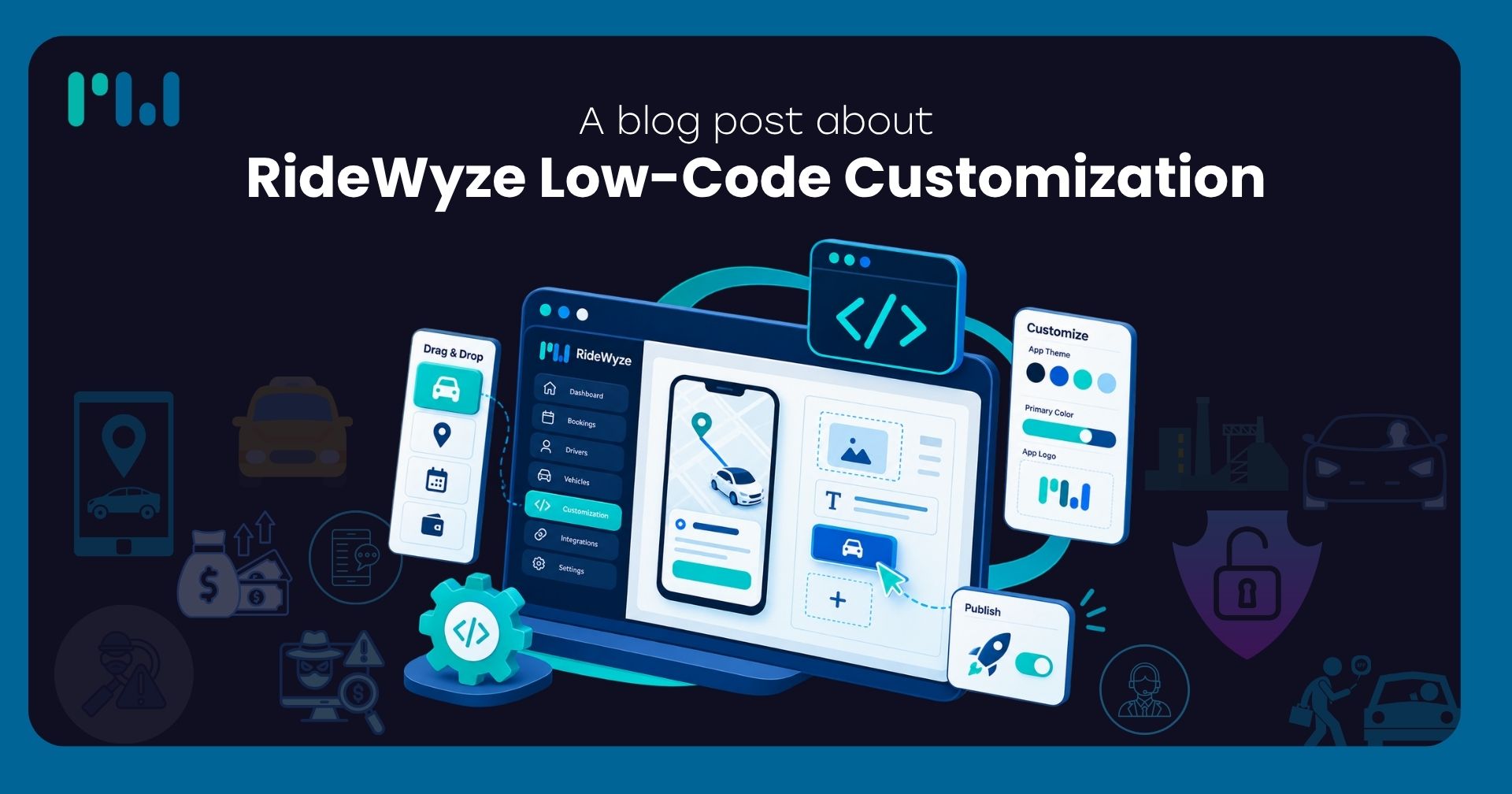
RideWyze's low-code and no-code customization capabilities are designed to solve exactly this problem. The platform gives operators the depth of customization that their specific market, brand, and operational requirements demand — without requiring development expertise, without long lead times, and without per-customization development costs. This blog explains what low-code and no-code customization means in the context of ride-hailing, what RideWyze specifically enables, and how operators across different market types use these capabilities to build platforms that feel genuinely native to their market rather than generic templates imposed on it.
In enterprise software, "low-code" and "no-code" refer to development approaches that enable users to configure and customize software through visual interfaces, configuration panels, and point-and-click tools — rather than writing code. The spectrum runs from fully no-code (zero technical skill required) through low-code (occasional scripting or API integration) to full custom development.
For ride-hailing operators, these terms translate into something concrete and practically important:
No-code customization means that an operator with zero technical background can open the RideWyze admin dashboard and within a single session: change their platform's colors and branding, add a new vehicle category, adjust pricing for a specific zone, create a promotional discount campaign, configure surge pricing thresholds, set driver document requirements, add a new service zone, and launch a push notification campaign — all without writing a single line of code.
Low-code customization means that operators who want deeper integrations — connecting a specific local payment gateway, linking to a third-party navigation API, feeding trip data into an external analytics platform, or building a custom corporate booking portal — can do so through RideWyze's open API with standard web development work, without needing to rebuild or modify the core platform.
The practical implication is that operators get the speed and simplicity of a pre-built platform combined with the customization depth of a purpose-built solution — without the cost or timeline of custom development.
The most immediately visible form of customization is brand identity. RideWyze's white-label architecture means that every passenger and driver-facing element of the platform carries the operator's brand, not RideWyze's.
<cite index="25-1">A white-label taxi app is a ready-made ride-hailing solution that businesses can customize, brand, and launch as their own platform.</cite> On RideWyze, this brand customization is configured through the admin dashboard with no technical expertise required:
This level of brand customization transforms a generic platform into an owned market identity — giving operators the competitive advantage of local brand recognition that global platforms cannot replicate. <cite index="27-1">The global ride-hailing segment was valued at $158.65 billion in 2025 and is forecast to reach $342 billion by 2030 at a CAGR of 16.61%. That growth isn't coming from Uber expanding into new zip codes. It's coming from new operators in new markets</cite> — and those operators win by feeling genuinely local, not by appearing to be a white-labeled version of something built elsewhere.
The second customization layer is service configuration — defining what services the platform offers, to whom, at what price, in which zones. Every aspect of this configuration is accessible through the admin dashboard without development work.
Vehicle categories — operators add, configure, and modify vehicle categories through the dashboard. Each category includes:
An operator can add a bike taxi category in the morning, test it with a small driver group in the afternoon, and make it live to all passengers the same evening — with no development involvement at any stage.
Zone management — service zones are defined using a visual geofencing tool in the admin dashboard. Operators draw zone boundaries on a map interface, configure what services are available within each zone, set zone-specific pricing rules, and manage surge pricing parameters by zone. Adding a new city, neighborhood, or coverage corridor is a map-drawing exercise, not a development project.
Pricing configuration — the complete pricing structure is configurable through the admin panel: base fares, per-kilometre rates, per-minute charges, minimum fares, surge multipliers, peak-hour pricing windows, flat-rate zone pricing, and promotional discount campaigns. Changes apply immediately across the live platform — operators can respond to competitive price changes or demand events in real time.
The third layer of no-code customization covers the functional experience for both drivers and passengers — the settings that determine how the platform behaves at every interaction point.
Driver onboarding configuration — operators specify which documents drivers must submit for each vehicle category, the verification workflow for each document type, and the automated messaging drivers receive at each stage of onboarding. A women-only service requires different driver documentation than a standard car service. A premium chauffeur category requires different vehicle quality standards than an economy ride. Each is configured independently through the dashboard.
Dispatch rules — operators configure how the dispatch engine prioritizes driver assignments: whether it weights purely on proximity, or also considers driver rating, vehicle match quality, or zone positioning. The configuration interface presents these as selectable priority settings rather than algorithmic parameters, making dispatch optimization accessible to operators without data science expertise.
Safety feature configuration — SOS alert destinations, trip sharing defaults, OTP verification requirements, and dashcam integration settings are all configured through the admin dashboard. Operators in markets with specific safety requirements configure additional verification steps without development work.
Referral and loyalty programs — referral code generation, reward structures, referral expiry rules, and redemption conditions are all configured through the admin panel's promotion management section. An operator can design and launch a referral campaign in an afternoon without any development involvement.
Notification campaigns — the push notification system allows operators to schedule and send targeted communications to passenger and driver segments based on booking history, zone, rating, or activity status — again, with no code.
RideWyze's analytics dashboard provides operators with a fully configurable reporting environment — selecting which metrics to track, which time periods to analyze, which zones to compare, and which driver or passenger cohorts to examine.
Custom report configurations can be saved and scheduled for regular delivery — a weekly driver performance summary sent to operations managers, a monthly revenue report for investors, a real-time dashboard view configured for the dispatch team's specific monitoring needs. All of this is point-and-click configuration, not development.
For operators who need data in specific formats for external tools — accounting software, investor reporting platforms, regulatory submissions — the export functionality generates structured data files in configurable formats without requiring a custom data pipeline.
The fifth customization layer is where low-code development enters — connecting RideWyze to external systems through the platform's open API. This layer is relevant for operators who want:
Payment gateway integration — connecting to a specific local payment provider not already in RideWyze's default set. The API documentation provides standard endpoints for payment processing integration, and most payment gateway providers have documented integration guides that a developer can implement in days, not months.
Mapping and navigation API integration — connecting to a regional mapping platform (Google Maps, HERE, OpenStreetMap, or local alternatives) for in-app navigation and route display. Operators in markets where Google Maps coverage is limited, or where local mapping providers offer superior accuracy, integrate their preferred navigation layer through the API.
Corporate travel system integration — connecting RideWyze to a corporate client's travel management system for automated booking, billing reconciliation, and expense reporting. This integration requires development work but is enabled by standard REST API endpoints that follow documented patterns.
Third-party analytics integration — feeding RideWyze trip data into external business intelligence platforms (Tableau, Power BI, custom databases) for advanced analysis. The API exports structured data in standard formats that analytics platforms consume without platform-specific development.
Multi-service expansion — as operators grow from ride-hailing into food delivery, package courier, or other service categories, the API layer connects new service-specific platforms (restaurant management systems, e-commerce order management) to the RideWyze dispatch engine.
The critical characteristic of RideWyze's API layer is that it is additive, not prerequisite. Operators launch without any API integration — using the platform's built-in capabilities from day one — and add integrations as specific business needs arise. There is no minimum integration requirement to go live.
The economic argument for low-code customization is concrete and significant.
<cite index="26-1">Building a ride-hailing platform from scratch can take anywhere from six months to over a year depending on project complexity, team size, and feature requirements. During this period, businesses may lose valuable market opportunities while competitors continue to expand. A white label solution significantly reduces deployment timelines because the core platform is already developed and tested.</cite>
With RideWyze's no-code configuration, operators complete platform setup in days to weeks — not months. The 30-day free trial period is typically sufficient to complete full configuration, onboard initial drivers, and take first bookings. This time-to-market advantage is particularly critical in competitive markets where every week of delay allows competitors to establish driver relationships and passenger loyalty.
<cite index="24-1">A SaaS subscription model provides budget certainty. You know exactly what the platform costs per month. Custom development ongoing costs — including maintenance, security updates, feature additions, and infrastructure management — are variable and tend to be underestimated in original business plans.</cite>
The no-code customization model means operators do not pay development costs every time they want to change a pricing rule, add a vehicle category, reconfigure a service zone, or launch a promotional campaign. These changes — which would cost hundreds to thousands of dollars in custom development time — take minutes in the RideWyze dashboard at zero incremental cost.
The most underappreciated benefit of no-code customization is the ability to test, learn, and iterate quickly. An operator who wants to test a flat-rate airport fare, a student discount program, or a new vehicle category in a specific zone can do so within hours — observe the results in the analytics dashboard — and refine or reverse the change the same day. This iteration speed is impossible with custom development, where every change requires a development cycle, testing, deployment, and review before passengers experience it.
For an operator launching their first ride-hailing service — whether a traditional taxi company going digital or a new startup entering a market — RideWyze's no-code customization is the difference between a viable launch and a delayed, expensive one.
The first-time operator uses the brand identity configuration to create their market identity. They use vehicle category setup to configure their existing fleet. They use zone management to define their coverage area. They use pricing configuration to set fares competitive with local market rates. And they use driver onboarding configuration to establish the documentation requirements appropriate for their regulatory environment. All of this happens in the admin dashboard — no developers, no lead time, no per-configuration cost.
<cite index="23-1">App-based booking now covers 93.1% of all ride-hailing transactions. Riders already know what they want — to book on a phone.</cite> The first-time operator needs to be on that platform, with their brand, serving their market, in days — not months. RideWyze's no-code configuration makes that timeline real.
For an operator expanding from one city to five, or from five to twenty, the customization challenge is different: each new city requires its own configuration — different pricing (adjusted for local market rates and fuel costs), different zone boundaries, different vehicle category availability (tuk-tuks available in City A but not City B), different regulatory compliance requirements (driver documents differ by jurisdiction).
RideWyze's multi-city architecture allows operators to configure each city independently within a single admin interface — without creating separate accounts or managing separate platform deployments. A pricing change in City A does not affect City B. A new vehicle category launched in City C is not visible to passengers in City D unless the operator activates it there. This granular, per-city customization capability is what makes multi-market expansion operationally manageable rather than administratively overwhelming.
For operators expanding beyond ride-hailing into food delivery, package courier, or other service categories, the low-code API layer is where customization enables growth. The core platform runs the ride-hailing operation with no-code configuration. New service categories are integrated through the API as the business grows — restaurant management systems for food delivery, e-commerce platforms for retail delivery, corporate booking portals for enterprise clients.
The critical advantage is that each API integration is additive — it extends the platform's capability without modifying the core. The ride-hailing operation continues running perfectly while new integrations are being developed and tested. There is no platform downtime, no migration risk, and no constraint on the pace of service expansion beyond the development capacity the operator chooses to invest.
A common confusion in evaluating ride-hailing platforms is conflating customization (changing the platform itself) with configuration (adjusting the platform's settings). The distinction matters because it determines the cost, speed, and technical requirements of making changes.
Configuration — adjusting parameters within the platform's existing feature set. Adding a vehicle category is configuration. Changing a fare rule is configuration. RideWyze makes all configuration changes available through the admin dashboard at no additional cost and with no development time.
Customization — adding new capabilities to the platform that do not exist in the standard feature set. Building a completely new booking flow is customization. Adding a bespoke corporate portal is customization. RideWyze's API enables customization through integration — operators add new capabilities without modifying the platform's core, preserving stability and update compatibility.
The practical implication for operators: the vast majority of changes you will need to make throughout your platform's lifetime are configuration, not customization. RideWyze's no-code configuration layer handles them all. True customization — adding genuinely new capabilities — is available through the API for the minority of requirements that fall outside the platform's standard feature set.
Not every platform that claims "full customization" delivers it. <cite index="22-1">Some platforms provide a low-cost starting point but with limited UX customization, lack of support, and feature updates only via paid upgrades. No API or integrations; no super-app or marketing functionalities.</cite> When evaluating any ride-hailing platform's customization claims, operators should verify:
Is pricing configuration genuinely self-service? Or does every pricing change require a support ticket and a waiting period?
How are new vehicle categories added? Through a dashboard configuration flow, or through a development request to the vendor?
What is the API documentation quality? An open API is only useful if the documentation is complete enough for a developer to implement integrations efficiently. Request documentation access before committing.
Does customization break on platform updates? If a vendor's platform update overwrites your configurations, your customization capability is illusory. Confirm that configuration settings persist through platform updates.
What is the actual customization timeline? For changes that should take hours in a well-designed no-code environment, test a representative change during the evaluation period rather than taking claimed timelines on faith.
RideWyze provides a 30-day free trial with full platform access specifically to allow operators to test these questions with real configuration work before committing — not based on vendor claims but on direct experience.
One of the most significant long-term advantages of RideWyze's SaaS model is that platform capabilities evolve continuously — new features, new integrations, new configuration options — without requiring operators to migrate, rebuild, or pay additional development costs for each addition.
When RideWyze adds new vehicle category support, new safety features, new analytics capabilities, or new payment gateway integrations, these become available to all operators on the current subscription — not as paid upgrades or separate modules. This continuous evolution model means the platform operators choose today will be more capable in twelve months than it is now — not because they invested in development but because RideWyze's development team continuously responds to what the market demands.
<cite index="25-1">Access to Advanced Features — white-label platforms incorporate innovations like AI-driven dispatch, smart routing, and automated payments as they become standard capabilities.</cite> For RideWyze operators, this means the AI demand forecasting, route optimization, and predictive dispatch capabilities described throughout this blog series are not static — they are continuously improving as the underlying technology advances and as more market data accumulates across the global operator base.
The gap between an idea for a ride-hailing service and a live, branded, configured platform accepting real bookings is measured in days on RideWyze — not months, not development cycles, and not six-figure software budgets.
RideWyze is trusted by over 4,000 clients globally. Its no-code admin dashboard gives non-technical operators the full depth of configuration they need to build a platform that feels genuinely native to their market. Its low-code API gives technical operators and developers the integration layer they need to extend the platform into multi-service operations and enterprise-grade connectivity.
Start your 30-day free trial at ridewyze.com — no credit card required, full platform access from day one. Configure your brand, set up your zones, add your vehicle categories, and take your first booking. The platform is ready when you are.
Low-code/no-code customization means that operators can configure and personalize their ride-hailing platform through visual admin dashboards and point-and-click interfaces — without writing code or hiring developers. In RideWyze's case, this covers brand identity, vehicle categories, pricing rules, service zones, driver requirements, safety features, promotions, and analytics — all adjustable from the admin dashboard by an operator with no technical background.
Yes. RideWyze's admin dashboard provides full self-service configuration for all pricing rules (base fares, per-km rates, surge parameters, minimum fares, promotional discounts) and vehicle categories (adding, modifying, or removing categories with independent pricing and requirements per category). Changes apply immediately to the live platform — no development cycle, no support ticket, no waiting period.
A generic branded template applies your logo to a fixed interface. RideWyze's white-label customization allows operators to configure not just visual identity (colors, icons, app name) but also functional behavior (vehicle categories, zone availability, pricing rules, dispatch logic, driver requirements, safety settings, and promotions) — all independently for their specific market. The result is a platform that behaves as if it was built for that market, not a global template with local colors.
No. The complete platform — passenger app, driver app, admin dashboard, and dispatch portal — is pre-built and launches through configuration, not development. Operators are typically live and taking bookings within 24–48 hours of completing setup. The 30-day free trial allows operators to complete the full configuration process and run real trips before committing to a paid plan.
RideWyze's open API supports integration with payment gateways (local and international), mapping and navigation providers, corporate travel management systems, third-party analytics platforms, restaurant management platforms for food delivery, e-commerce order management for retail delivery, and MaaS platforms for multi-modal journey planning. Each integration is additive — extending the platform's capability without modifying its core.
Adding a new service zone takes hours — the operator draws zone boundaries using the visual map tool, configures zone-specific pricing and vehicle availability, and activates the zone. Adding a new vehicle category also takes hours — selecting category type, configuring pricing, setting driver requirements, and activating it in the chosen zones. Both are admin dashboard operations with no development involvement.
Ready to elevate your ride-hailing business? RideWyze has the tools and expertise to help you succeed. Contact us for a personalized demo today!

Create a free account and get full access to all features for 30 days.No credit card needed. Trusted by over 4,000 Clients.


from 200+ reviews

Start your 30-day free trial.