Passenger

Team RideWyze Posted on 30 October 2025
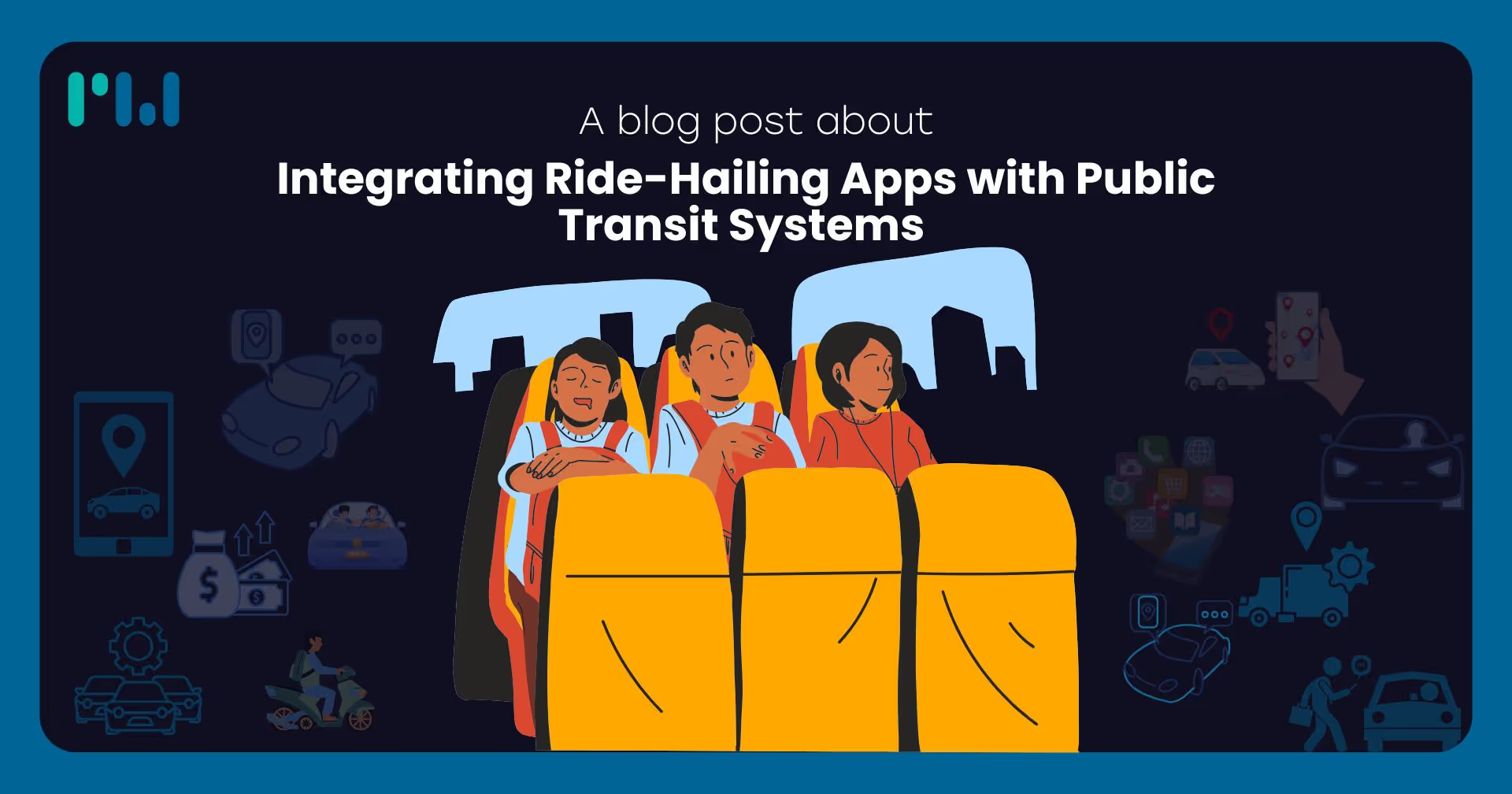
Urban mobility has always been about solving puzzles. Buses, trains, trams, and ferries form the backbone of public transport, but they don’t always get people exactly where they need to go. For years, riders have struggled with what’s often called the “first-mile/last-mile problem”—the challenge of getting from home to a transit hub and then from that hub to a final destination. That gap is where ride-hailing services like Uber, Lyft, and local transportation network companies (TNCs) are stepping in.
By integrating ride-hailing apps with public transit systems, cities are beginning to unlock a smarter, more sustainable, and more convenient way of moving people. But this isn’t just about technology. It’s about balancing efficiency, cost, equity, and sustainability to create a true multimodal ecosystem.
Over the past decade, ride-hailing has exploded worldwide. Uber alone now operates in more than 10,000 cities, while Lyft continues to dominate in North America. Initially, these services were seen as competitors to transit—convenient options that might lure people away from buses and subways.
Yet, the data paints a more nuanced picture. In Washington, D.C., a 2019 study showed that 34% of ride-hailing trips began or ended near Metro stations, suggesting that people already used Uber and Lyft as feeders. Similarly, pilot programs like the WMATA–Uber collaboration revealed that providing discounted Uber rides to Metro stations increased ridership at certain times of day.
Meanwhile, Denver made headlines when Uber integrated the city’s Regional Transportation District (RTD) transit data directly into its app. Riders can now plan multimodal trips, compare costs, and even purchase RTD tickets—all within Uber. This kind of partnership flips the old narrative: ride-hailing isn’t stealing riders, it’s extending the reach of transit.
Public transit is efficient in dense corridors, but it struggles in sprawling suburbs or neighborhoods without sidewalks. Imagine living a mile from the nearest bus stop or train station. For many, that’s too far to walk, especially at night or in bad weather. Without a good connection, those riders may simply drive instead.
This is where ride-hailing shines. Unlike fixed-route feeder buses that run empty half the time, ride-hailing can flex with demand. Agencies are discovering that subsidizing short Uber or Lyft trips is often cheaper than running underused shuttles. Arlington, Texas, famously replaced several low-ridership bus routes with a subsidized Via partnership, offering affordable on-demand rides that fed into main transit lines.
Elasticity data underscores the impact. In Chicago, researchers found that a 10% decrease in fares increases ridership by about 1.29%. Combine that with first-mile/last-mile coverage, and transit becomes far more appealing. In other words: fix the gaps, and people will show up.
The holy grail of urban transport is Mobility-as-a-Service (MaaS)—the ability to plan, book, and pay for all your travel in one place. Instead of juggling five apps (Uber for your car, Citymapper for planning, your transit agency’s app for tickets, Bird for scooters), MaaS bundles everything.
Helsinki’s Whim app is the poster child here. With Whim, users subscribe to a monthly plan that covers buses, trains, ride-hailing, taxis, and even car rentals. Riders don’t think about individual fares; they just pick the best mode for each leg of their journey.
But integration isn’t only about planning—it’s about payments. In Denver, Uber users can buy bus and rail tickets within the app, thanks to an API partnership with Masabi, a mobile ticketing platform. This kind of seamless ride-hailing transit ticketing removes friction, making multimodal journeys second nature.
Real-time data plays a role, too. If your train is delayed, the app can automatically suggest a connecting Lyft ride or reschedule your trip. This level of coordination turns ride-hailing into a true extension of the transit network rather than a standalone competitor.
When integrated, ride-hailing often increases—not decreases—transit ridership. Bogotá and Medellín provide compelling case studies: fare cuts combined with better access drove double-digit increases in bus ridership, showing how integration and affordability amplify one another.
Standalone ride-hailing has a reputation for increasing congestion. But integrated ride-hailing flips the script. By feeding riders into trains and buses instead of completing long solo car trips, it reduces vehicle miles traveled (VMT) and cuts traffic in dense urban cores.
For transit agencies, partnerships often make financial sense. Operating a half-empty feeder bus costs hundreds of dollars per hour. In contrast, subsidizing short ride-hailing trips can deliver the same service for less. Studies show that shared operating costs can be reduced by up to 60% when TNCs handle first-mile/last-mile trips.
Integration isn’t just about efficiency; it’s about equity. Late-night workers, seniors, or residents in transit deserts benefit most from reliable on-demand services. Pairing Uber or Lyft with public transit ensures they aren’t left behind.
The debate is ongoing. Chicago’s elasticity study revealed a -0.124 correlation between TNCs and transit demand, meaning ride-hailing sometimes pulls riders away. The trick lies in policy design: if ride-hailing is cheaper and faster than the bus, it will cannibalize transit. But if it’s structured as a feeder with incentives tied to transit use, the relationship becomes complementary.
Funding remains a sticking point. Who should pay for subsidized rides—the agency, the city, or the riders themselves? Pilot programs often succeed, but without stable funding models, they risk fizzling out. Policymakers need to weigh the OPEX savings of integrating ride-hailing against long-term subsidy sustainability.
Perhaps the most difficult challenge is data. To plan effective services, agencies need granular trip data. Yet Uber and Lyft are protective of their datasets. Without data-sharing agreements, it’s nearly impossible to measure success or design better multimodal systems. Privacy concerns complicate matters further, requiring careful regulation.
APIs (Application Programming Interfaces) are the unsung heroes of integration. They allow apps to share real-time information—like bus arrivals, ride-hailing ETAs, and fare calculations. Denver’s Uber Transit integration is a perfect case study of how APIs make multimodal ride-hailing public transport possible.
Technology also underpins seamless payments. Smart cards, QR codes, and NFC-enabled phones allow riders to hop between ride-hailing and public transit without thinking twice. Imagine tapping your phone once to pay for both your Lyft and your subway ride. That’s the future many agencies are working toward.
Artificial intelligence can take integration to the next level. Predictive algorithms can position ride-hailing cars near transit hubs when trains are due to arrive, ensuring riders get instant connections. By anticipating demand, AI reduces wait times and makes the system feel like a single coordinated network.
Arlington, Texas, is a famous example of a city that scrapped low-ridership bus routes in favor of subsidized ride-hailing. The result? Higher satisfaction, more flexibility, and lower costs per trip. But scaling this model requires careful policy oversight to avoid over-reliance on private operators.
Agencies and TNCs must set clear rules: fare structures, service standards, equity requirements, and—most importantly—data-sharing. Without structured agreements, integration risks being piecemeal and unsustainable.
Policymakers must guard against unintended consequences. If subsidies make solo Uber rides cheaper than the bus, ridership will drop. Smart frameworks should prioritize shared ride-hailing services that extend transit rather than compete with it.
Each case underscores one thing: context matters. The right combination of incentives, tech, and governance determines whether ride-hailing strengthens or weakens transit.
Integrating ride-hailing apps with public transit systems is more than a convenience upgrade—it’s a chance to reimagine urban mobility. Done well, it reduces first-mile/last-mile gaps, boosts ridership, lowers OPEX costs, improves equity, and curbs congestion.
But it won’t happen by accident. Cities need strong policies, open technology platforms, and transparent partnerships to make it work. Above all, they need to design systems that put public transit first, using ride-hailing as a supporting tool, not a replacement.
The future of mobility is multimodal, flexible, and user-centered. The cities that succeed will be those that make movement seamless—where the rider doesn’t care if they’re in a bus, a train, or a Lyft, because it all feels like one system.
Cities can integrate Uber with bus and rail systems by adopting a Mobility-as-a-Service (MaaS) approach, where one app lets riders plan, book, and pay for both modes. For example, Denver’s partnership with Uber and the Regional Transportation District (RTD) shows how API integration allows users to see real-time bus and rail schedules, compare ride-hailing connections, and even purchase transit tickets in the Uber app. Such seamless integration ensures that Uber supports public transit instead of competing with it.
Best practices for Lyft and transit agency partnerships include designing first-mile/last-mile solutions, offering subsidized shared rides instead of solo trips, and ensuring strong data-sharing agreements. Agencies like Dallas Area Rapid Transit have piloted partnerships with Lyft to connect riders to rail stations, showing that careful subsidy design and equity-focused policies can make these collaborations both cost-efficient and rider-friendly.
Whether ride-hailing increases or decreases public transit ridership depends on the policy framework. Studies from Bogotá, Medellín, and Mexico City show that when ride-hailing is cheaper, it can reduce bus ridership. However, when integrated with public transit—such as offering discounted ride-hailing trips to stations—it actually boosts transit ridership by solving the first-mile/last-mile gap. The key is structuring ride-hailing as a complementary feeder service rather than direct competition.
The most effective policy frameworks for subsidizing ride-hailing in transit integration prioritize shared rides, affordability, and equity. For example, Arlington, Texas replaced low-ridership buses with subsidized on-demand rides, saving money while improving access. However, to avoid undermining transit, subsidies should favor short trips to and from hubs, not long point-to-point rides that compete with buses and trains.
AI and real-time apps improve ride-hailing transit integration by predicting demand, positioning cars near stations when trains arrive, and suggesting the best transfer options in real time. This ensures faster connections, reduced wait times, and higher reliability. For example, predictive dispatch can direct ride-hailing cars toward busy hubs during peak hours, turning fragmented trips into a coordinated system.
Successful examples of ride-hailing and rail integration include Washington, D.C.’s Metro–Uber program, which provided discounted late-night station rides, Denver’s Uber–RTD ticketing integration, and Helsinki’s Whim app, which bundles ride-hailing, rail, buses, and car rentals under one subscription. Each model shows that when ride-hailing apps connect directly with transit hubs, riders benefit from a smoother multimodal journey.
Ready to elevate your ride-hailing business? RideWyze has the tools and expertise to help you succeed. Contact us for a personalized demo today!

Create a free account and get full access to all features for 30 days.No credit card needed. Trusted by over 4,000 Clients.


from 200+ reviews

Start your 30-day free trial.