Passenger

Team RideWyze Posted on 27 July 2026
When a passenger opens a ride-hailing app and sees their assigned driver's 4.8-star rating, they are not just reading a number. They are making a rapid, subconscious trust decision — one that determines whether they walk confidently to the pickup point or hesitate with their hand on the cancel button. That single data point, generated by the accumulated experiences of hundreds of previous passengers, is doing more work for your platform than any marketing campaign, any vehicle upgrade, or any pricing promotion could achieve.
Driver ratings are one of the most powerful mechanisms in the entire ride-hailing ecosystem. They are the accountability infrastructure that keeps service quality consistent at scale, the trust signal that converts new passengers into repeat users, the safety filter that protects vulnerable riders, and the performance feedback loop that helps good drivers get better and identifies poor performers before they damage your platform's reputation beyond repair.
In 2025, real-time safety features — including driver ratings, live trip sharing, and panic buttons — are now integral to over 90% of top ride-hailing apps globally. These features have contributed to a 22% reduction in safety-related complaints across the industry. The rating system is not an optional add-on. It is load-bearing infrastructure for any ride-hailing operation that intends to grow.
Yet many operators implement rating systems without fully understanding how to leverage them for maximum business impact. They collect ratings but do not act on them systematically. They allow bad ratings to accumulate without intervention. They fail to communicate the system's fairness to drivers, breeding resentment. And they miss the opportunity to use rating data as a strategic intelligence tool rather than just a passenger feedback form.
RideWyze builds its rating system as a central operational feature — not an afterthought. This blog examines why real-time driver ratings matter more in 2025 than at any previous point in the industry's history, what a well-designed rating architecture actually includes, how operators should use rating data strategically, and the specific tools RideWyze provides to make the rating system work for every stakeholder simultaneously.
Ride-hailing is fundamentally a trust transaction. A passenger is entrusting a stranger with their physical safety, their time, and often their knowledge of their home address and daily routine. In 2019, that trust was still relatively novel — passengers had fewer reference points and lower expectations. By 2025, passengers have used ride-hailing hundreds of times. They have formed precise expectations. They know what a 4.9-star driver feels like versus a 4.2-star driver. And they make increasingly sophisticated decisions based on that knowledge.
The driver rating is the primary proxy passengers use to calibrate their trust before a trip begins. A visible, credible, real-time rating system signals that the platform takes quality seriously enough to measure it continuously and make those measurements visible. Platforms that lack transparent, credible rating systems are increasingly viewed with suspicion — not just by passengers but by regulators who are watching how platforms self-govern their quality standards.
The safety context for ride-hailing in 2025 is more demanding than it has ever been. Background checks, while necessary, are a one-time snapshot. They catch historic disqualifiers but provide no signal about how a driver performs on a daily basis after passing that initial screen. Driver ratings — and the behavioral monitoring that feeds into them — are the continuous safety signal that background checks cannot provide.
Ride-hailing companies require drivers to maintain a minimum rating or face account deactivation. This minimum standard functions as a continuous, market-driven safety filter that is more responsive than regulatory inspection cycles or periodic re-certification programs. When a driver's rating drops below the threshold — because their driving has become aggressive, their vehicle unclean, their communication poor — the system responds automatically, without waiting for a formal complaint or an inspector's visit.
Passengers have internalized this dynamic. When they board a vehicle with a driver who has a 4.9-star rating across 2,000 trips, they feel meaningfully safer than they do with a driver carrying 4.1 stars after 200 trips. That feeling of safety translates directly into satisfaction, loyalty, and the willingness to recommend the platform.
In most urban markets in 2025, passengers have at least two or three ride-hailing options available. The switching cost between platforms is essentially zero — the apps are already installed. The reasons passengers stay loyal to a platform are limited: superior pricing, superior reliability, and superior experience. Driver rating quality is deeply connected to all three. High-rated drivers deliver better experiences. Better experiences create loyal passengers who book again. Consistent booking patterns improve driver earnings, which improves driver retention and therefore raises average fleet rating over time. The virtuous cycle compounds — but it requires a rating system functioning at the center of it.
Most operators think of driver ratings as a simple star scale. The most effective rating architectures in 2025 are substantially more sophisticated than that.
Ratings should update continuously as new trip feedback is received — not recalculate weekly or monthly. A driver who receives three poor ratings in a single day should have that signal visible to the dispatch system and the operator dashboard by the end of that day, not at the next reporting cycle. Real-time rating visibility allows rapid intervention — a phone call, a coaching message, or a temporary hold on dispatch assignments — before a developing performance issue becomes a pattern that damages multiple passengers' experiences.
RideWyze's analytics dashboard surfaces driver ratings in real time, with the most recent trip feedback immediately visible alongside the rolling average. Operators can set automated alerts when a driver's rating drops below a configured threshold, triggering a support response workflow.
A single overall star rating is a blunt instrument. A passenger who gives 3 stars because the vehicle was dirty is giving the same signal as one who gives 3 stars because the driver was rude or took a circuitous route. These are different problems requiring different responses — and a single number tells the operator nothing about which issue occurred.
Multi-dimensional rating prompts — asking passengers to evaluate cleanliness, driving quality, punctuality, and courtesy separately — produce dramatically more actionable intelligence. Riders give higher ratings to trips with fewer strong brakes and accelerations, confirming that specific driving behaviors have direct, measurable effects on satisfaction scores. When the rating system can capture this specificity, operators can give drivers targeted, evidence-based coaching: "Your overall rating is 4.3 but your driving smoothness score is 3.7 — here is what passengers are saying about that specifically."
The rating system's accountability function only works when there are clear, communicated consequences for falling below a minimum standard. Ride-hailing companies deactivate drivers who fall below minimum rating thresholds — this is a near-universal practice among serious platforms, and for good reason.
But the way these thresholds are communicated to drivers matters enormously. Drivers who understand from onboarding exactly what rating is required to remain active, what behaviors lead to low ratings, and what support is available to help them improve, are far more likely to respond to coaching than drivers who receive a deactivation notice without context. Transparency about the rating system's mechanics is a retention tool as much as an accountability tool.
The most sophisticated aspect of a well-designed ride-hailing rating architecture is mutual accountability: drivers rate passengers, and passengers rate drivers. This two-way feedback mechanism helps maintain quality standards, incentivize good behavior, and hold users accountable for their actions on both sides of the transaction.
For drivers, the ability to rate passengers is both a practical protection and a powerful morale signal. Knowing that a passenger who was rude, late, or disrespectful will receive a low driver rating — and that this rating will affect their future matching — communicates that the platform respects drivers as full participants in the service relationship, not just as service workers who absorb whatever behavior passengers direct at them.
For the platform, passenger rating data is a valuable quality signal. Consistently low-rated passengers generate disproportionate driver complaints, higher trip cancellation rates, and lower driver satisfaction. Identifying these passengers early and applying friction to their future bookings — requiring confirmation steps, limiting surge pricing protections, or in extreme cases, suspending accounts — protects the driver community and improves overall platform quality.
A transparent driver rating system encourages accountability while reducing resentment among drivers. When drivers know the system measures passengers as well as themselves, the rating feels fair rather than punitive.
The rating system's most underutilized function is intelligence generation. Operators who read aggregate ratings as a passive quality indicator are missing most of the value. Treated as a strategic data source, rating information reveals:
When rating data is mapped to pickup and drop-off zones, patterns emerge that would be invisible in aggregate statistics. A specific airport zone might have consistently lower ratings than city-center trips — pointing to pickup confusion, vehicle supply shortages, or a specific driver cluster assigned to that zone. A nightlife district might show rating spikes in the early morning hours — indicating a specific passenger demographic with higher complaint propensity or genuine service quality issues during late-night shifts.
Zone-level rating analysis transforms the platform's service quality map from a guess into a data-driven picture of exactly where performance is strong and where intervention is needed.
Driver ratings often vary systematically by time of day in ways that point to specific operational issues. Late-night ratings may be lower because of fatigue-related driving behavior. Monday morning ratings may spike because weekend events generated an influx of new, lower-experienced drivers to meet demand. Peak-hour ratings may drop because dispatch pressure leads drivers to rush trips in ways that sacrifice comfort for speed.
Understanding these temporal patterns allows operators to deploy targeted interventions: driver fatigue reminders for late-night shifts, coaching campaigns timed to demand surges, and quality monitoring intensified during historically low-rated time windows.
Comparing rating trajectories across driver cohorts — by onboarding month, by market zone, by vehicle type — reveals which recruitment channels produce the highest-quality drivers over time, which onboarding protocols generate better-performing new drivers, and which experience levels correlate with which rating distributions. This intelligence directly improves recruitment and training decisions.
Even operators who understand the importance of driver ratings frequently make design and operational mistakes that undermine the system's effectiveness. These are the most common failures and how RideWyze's architecture helps operators avoid them:
One of the most documented problems in ride-hailing rating systems is persistent inflation — the majority of ratings cluster at 4.8–5.0 stars, making meaningful differentiation nearly impossible. This happens because passengers feel social pressure to rate generously, particularly when the trip was merely adequate rather than genuinely excellent.
The solution is not to artificially lower scores, but to design rating prompts that capture genuine experience differentiation. Multi-dimensional prompts with specific behavioral questions produce more calibrated data. When platforms give passengers clear anchors for what each star level means — "5 stars = exceptional; 3 stars = average; 1 star = poor" — the distribution spreads in ways that make ratings genuinely informative.
Collecting ratings without acting on them is worse than not collecting them at all — it creates the expectation of accountability without delivering it. Passengers who leave detailed negative feedback and receive no response, and drivers who receive a low-rating notification with no coaching context, both learn that the rating system is performative rather than functional.
RideWyze operators who configure automated intervention workflows — where a rating below a threshold triggers a specific response protocol — ensure that every piece of feedback generates at least a minimum operational response. This makes the rating system feel active and responsive rather than passive and decorative.
If the only outcome of a low rating is eventual deactivation, the system becomes purely punitive without being developmental. Drivers who are approaching the minimum threshold with no coaching support or pathway to improvement will simply leave the platform before deactivation — contributing to churn without the system having served its quality improvement function.
The most effective rating systems use thresholds as triggers for coaching interventions long before deactivation becomes relevant. A driver dropping from 4.7 to 4.5 stars should receive a support outreach, a performance dashboard review with their operator, and targeted guidance on the specific dimensions where feedback has been negative — not a warning letter about account termination.
Drivers who receive low ratings for factors outside their control — traffic delays that caused a late arrival, a navigation error in the app rather than the driver, a passenger who was looking for a reason to give a low score — experience the rating system as unfair. Perceived unfairness is corrosive to driver morale and is a documented driver of churn.
Platform features that allow drivers to flag ratings as potentially unfair, dispute mechanisms for specific cases, and statistical approaches that identify outlier ratings from habitual low-raters all contribute to a system that drivers experience as reasonably fair — and therefore motivating rather than demoralizing. Dispute options and clear scoring criteria build confidence in the system, reducing resentment while maintaining accountability.
RideWyze's rating system is designed to serve three distinct stakeholders simultaneously — and the design recognizes that alienating any one of them undermines the system's effectiveness for all.
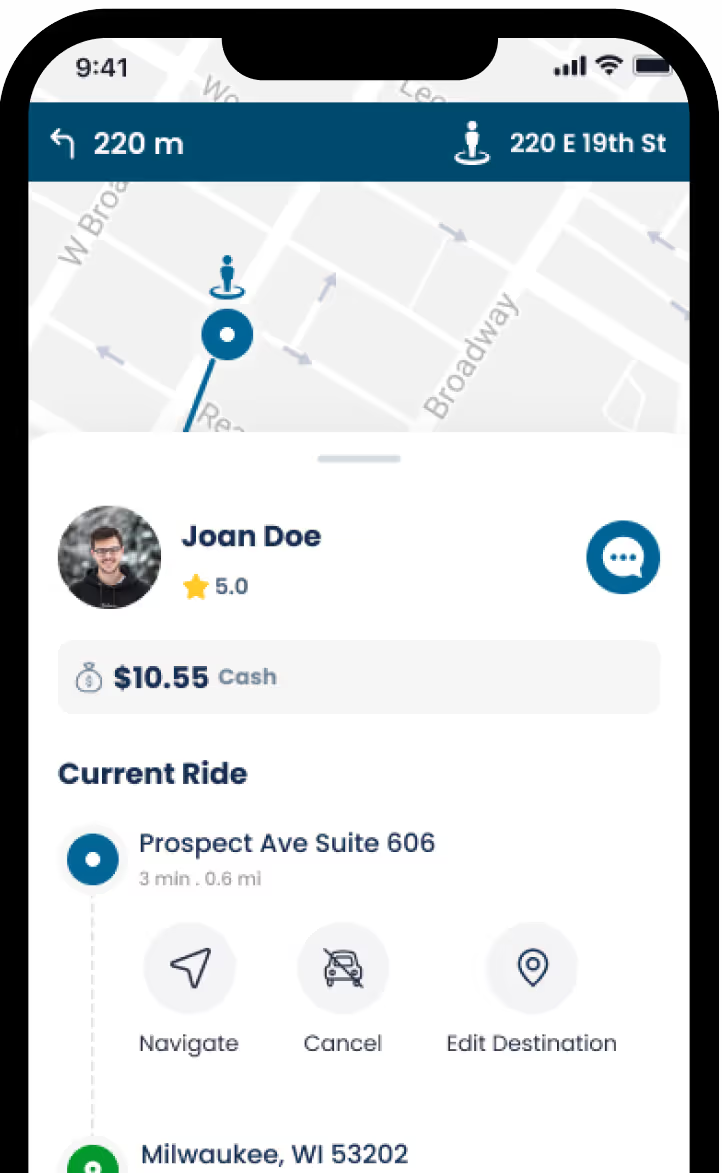
Every assigned driver's rating, number of completed trips, profile photo, and recent feedback summary is visible at the point of booking confirmation. This transparency gives passengers the information they need to make a confident boarding decision. Post-trip, the rating prompt appears immediately after trip completion, with optional category-specific feedback and a free text field for detailed comments. Passengers who leave detailed negative feedback receive acknowledgment — a message confirming their feedback has been received and acted upon.
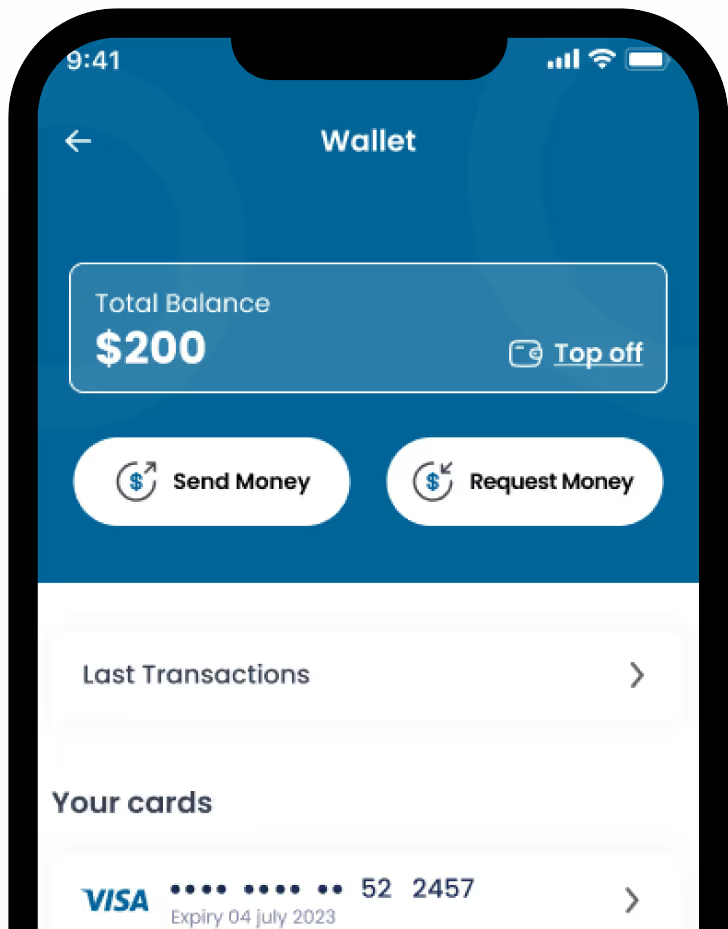
RideWyze's driver app displays each driver's current rating, recent trip-by-trip feedback summaries, and trend data showing whether their rating is improving or declining. Drivers can see which specific feedback categories are affecting their score, giving them actionable information rather than a number without context. The two-way rating feature allows drivers to rate passengers, with operator-configured thresholds that protect them from habitual problem passengers in future dispatch.
The operator analytics dashboard provides a complete real-time view of fleet rating health: average fleet rating, distribution of driver ratings across tiers, drivers approaching minimum thresholds, zone-level rating performance, and time-of-day quality trends. Automated alerts can be configured for any metric, and the export functionality allows rating data to be fed into operator-specific reporting and compliance frameworks. This is the rating system as a management tool, not just a passenger-facing feature.
An often-overlooked dimension of driver ratings in 2025 is their regulatory function. City transport authorities in many markets now require ride-hailing platforms to demonstrate active quality management — not just claim it. The rating system is the most legible evidence of that management.
Regulators are looking for: minimum quality thresholds enforced consistently, documented processes for addressing poor-performing drivers, systematic feedback collection from passengers, and data that demonstrates the system is functional rather than decorative.
Operators running RideWyze who can produce rating distribution reports, intervention logs, and driver performance trend data are demonstrably better positioned in regulatory conversations than operators whose quality management claims rest on anecdote rather than data.
The near-term evolution of driver rating systems in ride-hailing goes beyond star scores. AI is beginning to integrate objective telemetry data — braking events, acceleration patterns, phone handling, speed variance — with subjective passenger ratings to produce composite quality scores that are harder to game and more predictive of actual passenger experience.
Research from NBER studying Uber's telemetry data confirms that riders give higher ratings to trips with fewer strong brakes and accelerations — establishing a clear, measurable connection between driving behavior and satisfaction scores. This means objective telematics data can serve as a leading indicator of rating trends, allowing operators to intervene before a driver's behavior deteriorates enough to generate multiple passenger complaints.
RideWyze's IoT integration capability — connecting telematics data from vehicle sensors to the driver performance dashboard — positions operators to implement exactly this kind of blended quality scoring as it becomes standard practice across the industry.
Driver ratings are not a passive feature. They are an active management system — one that, when designed well and used strategically, improves service quality, builds passenger trust, protects drivers, and generates the operational intelligence that makes every other platform decision smarter.
RideWyze gives operators the rating architecture, the analytics tools, and the intervention workflow capabilities to make driver ratings work as hard as they should. Trusted by over 4,000 clients globally, RideWyze is built for operators who understand that quality is not a slogan — it is a system.
Start your 30-day free trial at ridewyze.com — no credit card required, full platform access from day one.
Real-time driver ratings are the primary trust and quality signal in ride-hailing. They tell passengers what level of service to expect before a trip begins, create continuous accountability for driver performance, protect passengers by filtering out consistently poor performers, and give operators the data needed to manage fleet quality systematically. Real-time safety features including driver ratings have contributed to a 22% reduction in safety-related complaints globally across the industry.
The two-way rating system creates mutual accountability. Passengers know their behavior affects their own rating and future ride-matching, which encourages respectful conduct. Drivers can rate passengers, protecting them from being repeatedly matched with problematic passengers. Platforms that implement two-way ratings foster a culture of mutual respect that improves experience quality for everyone on the platform.
Minimum rating thresholds vary by platform but typically fall in the 4.4–4.6 star range. Drivers falling below the threshold face warning notifications, coaching interventions, and ultimately account deactivation if ratings do not recover. Critically, the threshold should be clearly communicated at onboarding and accompanied by coaching support rather than used solely as a deactivation mechanism.
Driver ratings are one of the strongest predictors of passenger loyalty in ride-hailing. Passengers who consistently experience high-rated drivers develop platform loyalty that extends beyond pricing — they stay because the experience is reliably good. Conversely, even a single low-rated trip experience can push passengers to evaluate competitor platforms, especially when the switching cost is effectively zero.
Beyond fleet-level averages, operators should analyze rating data by geographic zone, time of day, trip type, and driver cohort. Zone-level rating patterns reveal where service quality is weakest. Time-of-day trends identify operational pressure points that affect driver performance. Cohort analysis reveals which onboarding processes produce better-performing drivers over time. RideWyze's analytics dashboard surfaces all of these dimensions for systematic quality management.
An overall star rating aggregates the entire trip experience into a single score, making it impossible to identify which specific aspect of the service caused dissatisfaction. Multi-dimensional rating prompts ask passengers to evaluate specific categories — vehicle cleanliness, driving quality, punctuality, communication — producing actionable data for targeted coaching. Research confirms that specific driving behaviors like harsh braking and rapid acceleration have direct, measurable impacts on satisfaction scores.
Ready to elevate your ride-hailing business? RideWyze has the tools and expertise to help you succeed. Contact us for a personalized demo today!

Create a free account and get full access to all features for 30 days.No credit card needed. Trusted by over 4,000 Clients.


from 200+ reviews

Start your 30-day free trial.