Passenger

Team RideWyze Posted on 9 July 2026
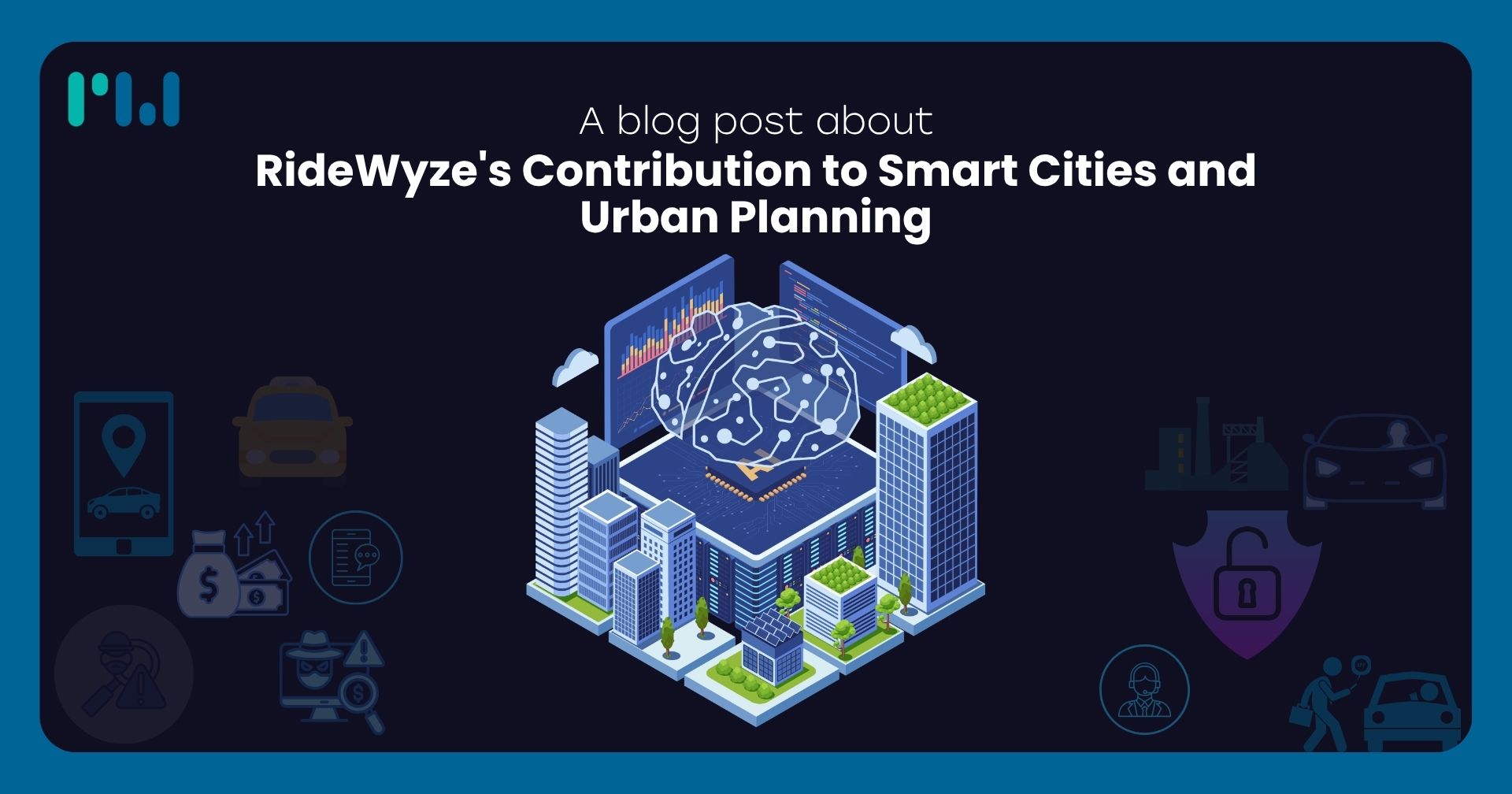
The city of the future is not being built from concrete and steel alone. It is being built from data — real-time streams of movement, demand, congestion, and behavior that flow continuously through millions of connected devices, platforms, and sensors. At the center of this data ecosystem sits one of the most active generators of urban mobility intelligence in existence: the ride-hailing platform.
Every trip completed on a ride-hailing app produces a rich data record — where passengers originate, where they travel, when they travel, how long it takes, which routes are congested, and which neighborhoods are underserved. At scale, across thousands of daily trips in a single city, this data becomes one of the most valuable inputs city planners, traffic engineers, and urban policy makers can access.
The global ride-hailing market, estimated at between $74.9 billion and $191 billion in 2025, is projected to grow to $441 billion by 2034. This growth is increasingly driven not just by consumer demand for convenient on-demand transport, but by smart mobility policies and data-sharing frameworks that allow public agencies and private platform operators to collaborate for smarter, more sustainable city operations.
RideWyze sits at the intersection of these two forces — delivering a powerful on-demand ride-hailing platform for operators while simultaneously generating the mobility intelligence, integration capabilities, and city-aligned features that make smart urban planning possible. This blog explores exactly how RideWyze and well-designed ride-hailing platforms contribute to smarter cities — across data, infrastructure, transit integration, sustainability, and equity.
A smart city uses digital technology, data analytics, and connected infrastructure to improve the quality of urban services, optimize resource use, and enhance the lives of residents. Core pillars include:
Ride-hailing platforms connect to every one of these pillars. Smart cities like Singapore, Seoul, and Dubai have pioneered data-driven transport planning, integrating ride-hailing systems with urban traffic management — resulting in shorter commute times, better fleet utilization, and reduced emissions. Cities that embrace intelligent mobility report up to 30% improvements in ETA accuracy and 20% reductions in traffic congestion.
For ride-hailing operators, this smart city agenda is not just good for the city — it is good for business. Operators whose platforms generate usable mobility data, integrate with transit systems, and demonstrably contribute to urban sustainability goals are better positioned to maintain operating licenses, win municipal contracts, and expand into new markets.
Ride-hailing apps share anonymized and aggregated data with smart city hubs to enhance urban planning and transportation management. The data includes metrics such as trip origins and destinations, travel durations, peak demand times, and congestion patterns — intelligence that would otherwise require expensive manual surveys or traffic studies to collect.
This data is transformative for city planners because it is:
Continuous — collected 24 hours a day, 365 days a year, across every trip on the platform. No other mobility survey achieves this coverage.
Granular — precise origin and destination coordinates, timestamped to the minute, broken down by vehicle type, trip duration, and route.
Real-time — unlike quarterly traffic surveys, ride-hailing mobility data reflects what is happening on city streets today — enabling rapid response to emerging congestion patterns or underserved demand zones.
Comprehensive — covering diverse trip types including airport transfers, late-night nightlife journeys, early-morning commutes, and event-driven surges that fixed transit data misses entirely.
Cities like Boston and Toronto have already begun publishing real-time congestion maps that help both ride-hailing drivers and city officials avoid the worst traffic jams. New York's plan to reroute traffic based on live ride-sharing activity is being watched as a potential global model. Transportation planning can be significantly improved by integrating real-time data from traffic sensors, public transit systems, and ride-sharing platforms — and RideWyze-powered operators can be active contributors to this intelligence layer.
One of the most important applications of ride-hailing data in urban planning is identifying where formal transport networks fail. When a consistent pattern emerges of high ride-hailing demand in a specific area at specific times — and those patterns are not served by existing bus or metro routes — city planners have evidence-based justification for infrastructure investment.
Ride-hailing data has been used to:
Deploying ride-sharing services for first and last-mile trips to and from public transportation stops — where ride-hailing fills the gap between home and the transit network — can reduce per-journey greenhouse gas emissions by 55 to 80% compared to private car use. This positions well-integrated ride-hailing not as a competitor to public transit, but as its essential complement.
The single most powerful way ride-hailing platforms contribute to smart urban planning is by solving the first-mile and last-mile problem — the gap between where people live or work and where the nearest public transit stop serves.
Public transit is most efficient when it operates on high-frequency, high-capacity trunk routes. But fixed routes cannot serve every street, every neighborhood, and every origin-destination combination. This is where on-demand ride-hailing becomes structurally essential:
The first-mile journey — from a passenger's home or hotel to the nearest metro or bus station — is often the barrier that makes car ownership feel necessary. If ride-hailing reliably covers this gap, more passengers will choose transit over private cars for the main leg of their journey.
The last-mile journey — from the transit station to the final destination — faces the same challenge. Without reliable last-mile connectivity, transit users abandon the system in favor of driving door-to-door.
RideWyze operators who partner with municipal transit authorities to provide scheduled, coordinated last-mile services at key station hubs are providing exactly the infrastructure bridge that smart city planners are actively seeking. Ride-hailing dominates the Mobility-as-a-Service (MaaS) market with a 45.85% share in 2025, and micro-mobility services are emerging as the fastest-growing complement — together forming the multi-modal ecosystem that smart cities require.
Mobility-as-a-Service (MaaS) platforms — unified digital interfaces that allow passengers to plan, book, and pay for journeys across multiple transport modes — represent the future of urban mobility. In cities like London and Tokyo, digital mobility platforms are already synchronized with public transit APIs. Commuters can plan journeys with real-time visibility into multiple transport options — from buses and metros to shared bikes and ride-hailing — through a single interface.
For ride-hailing operators, becoming part of this MaaS ecosystem is both a business opportunity and a contribution to smarter urban mobility. The pathway involves:
API integration with transit data — connecting RideWyze's booking API to city transit apps and national mobility platforms, so passengers can book a ride-hailing connection as part of a multi-modal journey rather than as a standalone trip
Unified payment and ticketing — enabling passengers to pay for their entire journey — subway, ride-hail, and e-scooter — through a single transaction, removing the friction that currently pushes commuters toward single-mode car travel
Coordinated scheduling — aligning ride-hailing pickup availability with transit departure times, so a passenger can reliably connect from home to the train station without uncertainty about wait times
Data contribution to city mobility platforms — sharing anonymized aggregate trip data with urban mobility authorities to inform transit network planning and MaaS platform development
Singapore's Smart Nation blueprint integrates public transit, micro-mobility, and unified payments into a single citizen app — widely regarded as the global best-practice model for multi-modal urban mobility integration. Operators building on RideWyze in major urban markets have the platform infrastructure to participate in exactly this kind of ecosystem.
Urban sustainability is one of the defining priorities of smart city planning globally. Transport accounts for a disproportionate share of urban carbon emissions, and ride-hailing platforms — done well — can be powerful tools for decarbonizing urban movement.
Every shared ride replaces two or more separate private car trips. Every well-integrated ride-hailing service that enables a commuter to leave their car at home and use transit plus a hail for the first/last mile removes a private vehicle from the urban road network permanently.
Research modeling the impact of widespread ride-sharing on parking infrastructure has found that highly optimized on-demand fleets could dramatically reduce the number of vehicles required to serve a city — with direct implications for land use. Land currently dedicated to parking — an estimated 30% of urban core real estate in many cities — could be repurposed for housing, parks, and public spaces. This is the kind of long-term urban planning transformation that ride-hailing data and technology makes possible.
RideWyze is actively developing EV-compatible fleet management tools. Operators building or transitioning to electric fleets on the platform gain specific advantages for smart city sustainability goals:
Governments in cities worldwide are already offering incentives for electrified ride-hailing fleets through carbon credit schemes and EV transition subsidies. RideWyze operators who build EV-ready fleets today are positioning for both regulatory advantage and long-term cost savings.
Smart city planning increasingly prioritizes not just efficiency, but equity — ensuring that improved mobility infrastructure reaches all urban residents, including those in low-income neighborhoods, peripheral suburbs, and communities historically underserved by formal transit.
Ride-hailing platforms have a complex relationship with equity. When poorly managed, they concentrate service in affluent, high-density areas and underserve low-income neighborhoods. When well-designed and regulated, they become essential connectors for communities that lack practical alternatives.
RideWyze's platform enables operators to build equity-conscious services through:
Multilingual support — the platform's multilingual architecture ensures passengers and drivers can interact in their native language, removing a significant barrier for immigrant and non-English-speaking communities that are often concentrated in transit-underserved neighborhoods.
Zone-based service expansion — operators can deliberately configure coverage zones to include underserved areas, set pricing that makes rides accessible to lower-income passengers, and use demand analytics to identify where service gaps are most acute.
Accessibility features — operators can deploy vehicle categories appropriate for passengers with mobility requirements, and configure the booking flow for accessibility, supporting compliance with ADA and regional accessibility standards.
SMS-based booking — RideWyze's SMS integration enables passengers without smartphones or reliable data connections to book rides via text message — extending access to demographics that app-only platforms exclude.
For city governments looking to achieve smart city goals that include all residents — not just tech-equipped, affluent commuters — ride-hailing operators on platforms like RideWyze who can demonstrate active equity commitments are valuable partners.
As cities become smarter, they are also becoming more sophisticated in how they regulate ride-hailing. The era of uncontrolled platform growth is over in most major markets. Today, operators face requirements around driver background checks, insurance standards, data reporting, accessibility mandates, and increasingly, emissions targets.
Operators who position themselves as active smart city partners — rather than adversaries of regulation — are consistently better positioned to maintain favorable operating conditions.
RideWyze's compliance and reporting tools help operators meet this challenge:
More cities are demanding anonymized information from platforms so they can spot traffic patterns and adjust traffic lights or bus schedules. RideWyze operators who have the systems to provide this data responsibly and consistently are the operators who get to grow.
For operators on the RideWyze platform who want to position their service as a genuine smart city mobility partner — rather than just a taxi app — these are the practical steps that create that relationship:
Step 1 — Engage your local transport authorityContact the city's transport department or mobility authority to understand their data needs, partnership frameworks, and integration opportunities. Many cities now have formal mobility data partnership programs that operators can apply to participate in.
Step 2 — Enable data reporting infrastructureEnsure your RideWyze instance is configured to generate the anonymized, aggregated trip data reports that municipal partners require. This includes trip counts by zone and time window, OD patterns, and vehicle type breakdowns.
Step 3 — Identify first/last-mile partnership opportunitiesMap the transit hubs in your coverage area — metro stations, bus terminals, rail stations — and propose coordinated pickup zones, scheduled connection services, or subsidized transit-link rides in partnership with the transport authority.
Step 4 — Commit to an EV transition roadmapEven if your current fleet is entirely conventional, developing and publishing a timeline for EV fleet integration signals city-aligned sustainability ambition — and often opens access to government incentive programs.
Step 5 — Participate in smart city working groupsMost major cities have smart mobility working groups, transport innovation forums, or urban planning consultation processes. Showing up as an engaged operator — not just a license applicant — builds the long-term relationships that protect and grow your operating position.
The contribution of ride-hailing to smart cities is set to expand dramatically as autonomous vehicle (AV) technology matures. Autonomous ride-hailing fleets — vehicles operating without human drivers, managed entirely by platform AI — will generate even richer urban mobility data and enable even tighter integration with smart city infrastructure.
Connected robotaxi services are already sharing data with traffic management systems to optimize flow and reduce congestion by up to 15% in current pilot programs. As AV technology scales, ride-hailing platforms will effectively become mobile infrastructure — a distributed sensor network that maps, monitors, and adapts to city conditions in real time while simultaneously providing transportation.
RideWyze is actively preparing for this evolution, with platform architecture designed to support autonomous vehicle integration as the technology becomes commercially viable. Operators building on RideWyze today are building on a foundation that will scale with the smart city agenda — not be left behind by it.
Whether you are launching a ride-hailing service in a city that is just beginning its smart mobility journey, or scaling an operation in a market where data integration and transit partnership are already requirements, RideWyze gives you the platform infrastructure to be on the right side of the smart city equation.
Start your 30-day free trial at ridewyze.com — full platform access, no credit card required. Explore how our API-connected, analytics-rich, multilingual platform enables operators to contribute to — and benefit from — the urban mobility transformation happening in cities worldwide.
Ride-hailing platforms generate continuous, real-time mobility data — trip origins and destinations, travel durations, peak demand patterns, and congestion points — that city planners use to make evidence-based decisions about transit investment, infrastructure development, and traffic management. This anonymized aggregate data is one of the most valuable inputs available to modern urban planners.
Ride-hailing fills the critical gap between passengers' homes or workplaces and the nearest public transit stop — the first and last mile that fixed transit routes cannot efficiently serve. Well-integrated ride-hailing connections to transit hubs can reduce per-journey greenhouse gas emissions by 55–80% compared to private car use on the same trip.
Mobility-as-a-Service platforms provide unified digital interfaces where passengers can plan, book, and pay for multi-modal journeys — combining buses, metros, bikes, and ride-hailing through a single app. RideWyze's open API architecture enables operators to integrate their ride-hailing service into city-level MaaS platforms, allowing rides to be booked as part of a connected urban journey.
RideWyze supports sustainability through AI route optimization that reduces unnecessary vehicle miles traveled, shared ride features that put more passengers per vehicle, EV fleet integration tools including battery monitoring and range-aware dispatch, and analytics that generate carbon performance data for regulatory reporting.
Yes. RideWyze's platform generates the anonymized, aggregated mobility data that municipal transport authorities increasingly require from ride-hailing operators. Automated reporting tools allow operators to submit regulatory-standard trip data, supporting both compliance requirements and active smart city partnership programs.
When properly designed, ride-hailing extends transport access to communities underserved by formal transit — including low-income neighborhoods, peripheral suburbs, and areas with limited bus or metro coverage. RideWyze supports equity-conscious service design through multilingual apps, zone-based coverage configuration, accessibility features, and SMS-based booking for passengers without smartphone access.
Ready to elevate your ride-hailing business? RideWyze has the tools and expertise to help you succeed. Contact us for a personalized demo today!

Create a free account and get full access to all features for 30 days.No credit card needed. Trusted by over 4,000 Clients.


from 200+ reviews

Start your 30-day free trial.