Passenger

Team RideWyze Posted on 7 Nov 2025
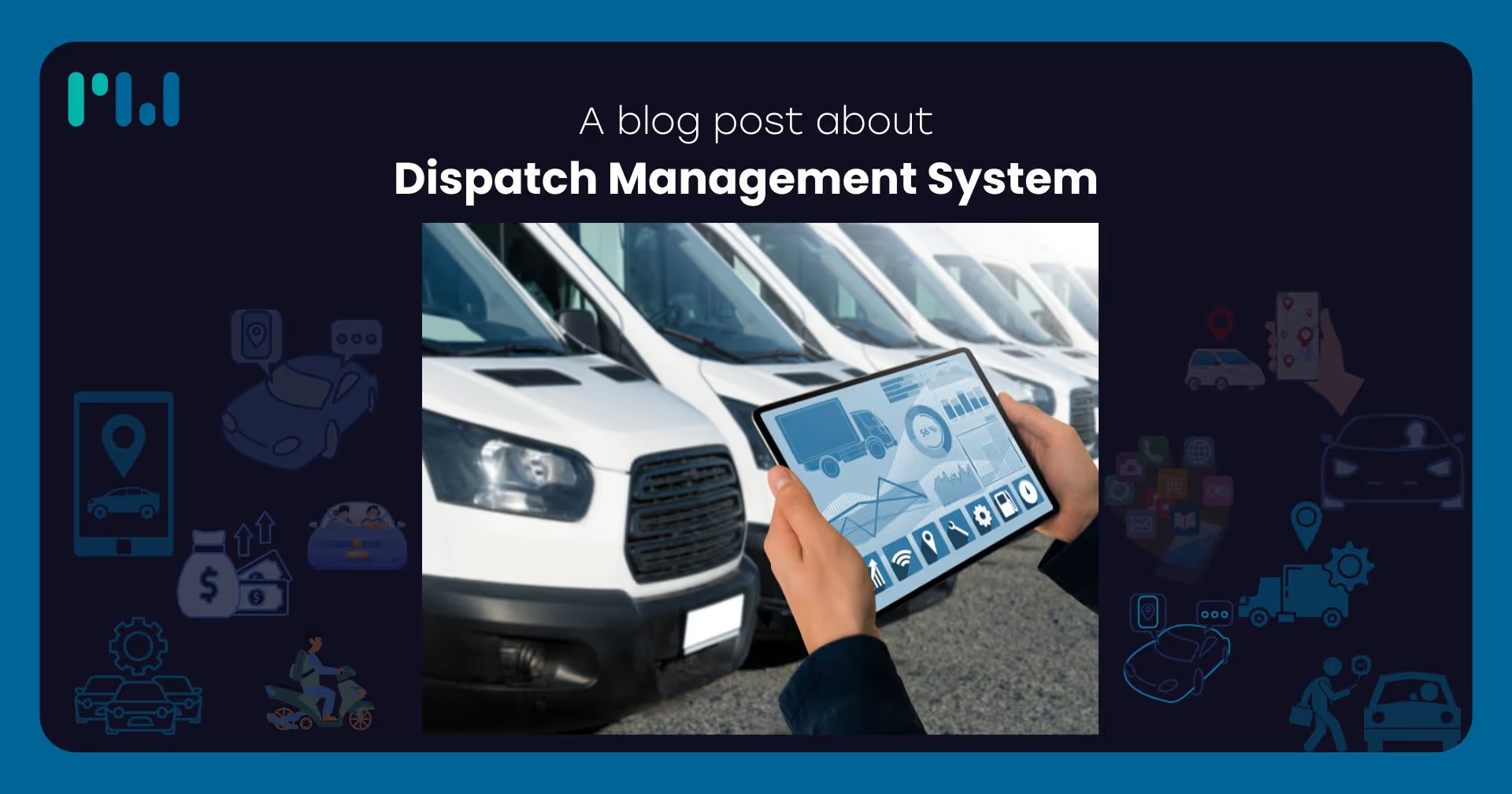
The logistics and transportation sectors have entered a digital transformation era where real-time data, predictive analytics, and automation define operational excellence. A dispatch management system (DMS) sits at the heart of this transformation — coordinating fleets, optimizing routes, and ensuring every delivery or service call reaches its destination on time.
From taxi dispatch platforms to public-transit bus control software, the role of dispatching technology extends across almost every industry that relies on mobility. As global competition intensifies and customer expectations rise, businesses are investing heavily in smart, connected, and AI-powered dispatch solutions to maintain agility, reliability, and cost-efficiency.
This comprehensive guide breaks down everything you need to know about modern dispatch management systems — from market trends and technologies to KPIs and future innovations shaping 2030 logistics.
A dispatch management system is a centralized software solution that automates the assignment, tracking, and coordination of jobs, vehicles, and personnel. In simple terms, it’s the digital brain behind scheduling and operational decision-making in fleet-driven businesses.
Historically, dispatchers relied on manual methods — phone calls, spreadsheets, or paper-based scheduling. These outdated approaches created delays, miscommunication, and inefficiencies that hurt profitability. Modern dispatch management systems eliminate these challenges by offering real-time GPS tracking, AI-powered scheduling, and two-way mobile communication between drivers and operations teams.
Businesses ranging from logistics companies and food delivery networks to public transportation and emergency response teams leverage dispatch systems to maintain accuracy, transparency, and timeliness. With these systems, dispatchers can visualize all ongoing operations, instantly reassign jobs, and respond to changing conditions within seconds.
Automation is the backbone of modern fleet management. In today’s data-driven world, relying on manual processes for dispatching is both time-consuming and error-prone. Automated dispatching ensures seamless coordination, enabling organizations to scale operations while maintaining performance consistency.
Automated systems analyze incoming job requests, vehicle locations, driver availability, and delivery deadlines to determine the most efficient match. Instead of spending valuable time manually assigning tasks, the software executes these decisions in milliseconds, minimizing idle time and maximizing vehicle utilization.
According to 2025 industry reports, companies adopting AI-based auto-scheduling have achieved up to 30% improvement in productivity and 15–20% reduction in operating costs. Moreover, automation ensures fairness in workload distribution and improves employee satisfaction — as drivers are assigned routes that best align with their skills, proximity, and preferences.
The global dispatch management system (DMS) market has seen remarkable growth in recent years. As of 2025, it is valued at approximately USD 800 million for the vehicle dispatch segment, while the bus dispatch management software market stands at around USD 2.7 billion. These figures illustrate a robust industry poised for expansion.
By 2028, analysts forecast the vehicle dispatch market to reach nearly USD 1.5 billion, implying a 10% CAGR. Similarly, bus dispatch systems are expected to hit USD 5.8 billion by 2034, with an average CAGR of 9–11% across multiple studies.
This growth is propelled by rising demand for cloud-based fleet management, real-time route optimization, and AI-enabled logistics. Additionally, the increasing adoption of shared mobility, public transit digitization, and e-commerce delivery ecosystems continues to fuel global DMS adoption.
Cloud deployment dominates the dispatch software landscape. In 2024, cloud-based dispatch systems represented 62–63% of the global bus DMS market — amounting to roughly USD 1.5 billion in revenue. This number is expected to grow at an 11% CAGR through 2034, outpacing on-premise solutions due to cost efficiency and scalability.
For vehicle dispatch systems, standalone cloud solutions accounted for around USD 150 million in 2025, growing at an estimated 15% annual rate. Businesses increasingly prefer cloud SaaS models because they offer accessibility from any location, reduced IT maintenance, and automatic feature updates without costly downtime.
At the foundation of every successful dispatch management system lies real-time GPS tracking. This functionality allows dispatchers to monitor driver positions, estimate arrival times, and adjust assignments instantly when unexpected delays occur.
GPS-enabled visibility reduces uncertainty across the supply chain. Customers can track their deliveries, managers can identify inefficiencies, and drivers receive optimized navigation routes. Such transparency minimizes idle time, prevents route overlaps, and improves communication between field and back-office teams.
The integration of AI route optimization is revolutionizing dispatch logistics. Algorithms analyze data such as road conditions, delivery urgency, fuel consumption, and driver history to propose the most efficient routes. This technology has been shown to reduce delivery windows by up to 30%, lowering fuel expenses and carbon emissions.
AI-based route planning also allows for dynamic adjustments in real-time. If traffic congestion, weather changes, or order cancellations occur, the system recalculates routes on the fly — keeping operations smooth and efficient.
IoT (Internet of Things) integration enhances dispatch management systems with advanced telematics. Sensors embedded in vehicles transmit vital data — including fuel usage, engine diagnostics, tire pressure, and cargo conditions — directly to the central platform.
These insights help dispatchers proactively schedule maintenance, avoid breakdowns, and ensure vehicle safety. In temperature-sensitive deliveries (like pharmaceuticals or perishables), IoT enables real-time monitoring of cargo integrity, ensuring compliance and quality control.
Cloud-native systems are the preferred architecture for modern dispatch platforms. They eliminate the need for local servers, reduce IT costs, and provide 99.9% uptime for mission-critical operations. Businesses can access data anywhere and anytime, making global collaboration effortless.
Scalability is another major advantage. During seasonal spikes or emergencies, the system can automatically scale resources, handling thousands of concurrent dispatches without latency or service disruption.
With the rollout of 5G networks, communication latency has dropped dramatically. 5G-enabled dispatch control towers ensure near-instant data transmission between vehicles and operations centers. The result is faster decision-making, improved route accuracy, and uninterrupted real-time coordination — even in high-density urban areas.
This connectivity also opens doors to autonomous dispatching, where AI can make instantaneous allocation decisions based on live data streams.
Timely delivery is a defining factor for business reputation. A DMS uses predictive ETAs, traffic-aware routing, and priority job scheduling to ensure maximum punctuality. Companies using dispatch systems report 95–99% on-time delivery rates, leading to improved customer satisfaction and reduced refund claims.
By minimizing empty miles, reducing idling, and optimizing job assignments, dispatch software directly cuts operational costs. The result? A 15–25% decrease in cost-per-dispatch and a significant reduction in resource wastage. These savings make DMS adoption a financially sound investment.
Fleet utilization measures how effectively vehicles are being used. AI-powered systems can increase utilization rates by 20–30%, ensuring that every truck, van, or bus contributes maximally to revenue-generating activities.
Automation’s impact extends beyond cost savings. Businesses typically see full ROI within the first year after implementation. Fewer manual interventions, fewer errors, and faster turnaround times combine to deliver tangible value across all operational layers.
These algorithms intelligently assign jobs based on rules like driver skill, location, load weight, and delivery deadlines. They adapt continuously, ensuring workload balance and efficiency.
Unlike static route plans, dynamic routing adjusts in real-time based on changing variables — traffic jams, detours, or last-minute order modifications. It helps reduce delivery time and enhances service reliability.
Using big data and AI, predictive ETA engines calculate highly accurate delivery times. This feature reduces “where’s my order?” queries by up to 40%, enhancing customer experience.
These mobile applications create a direct communication bridge between drivers and the control center. Features such as digital task acceptance, photo uploads, and live status updates simplify coordination, especially in field-service industries.
Digital POD systems replace manual paperwork with e-signatures and image verification. This ensures immediate confirmation, fewer disputes, and a smoother payment cycle.
For e-commerce and parcel services, last-mile dispatch systems handle route optimization, driver assignment, and real-time tracking. These platforms enhance delivery density, shorten delivery windows, and reduce transportation costs — key factors in customer retention.
Utility, telecom, and repair sectors rely on DMS platforms to dispatch technicians efficiently. Systems ensure each technician has the right tools and location details, increasing first-time fix rates by 25% and improving workforce productivity.
Bus dispatch software is vital for city transportation authorities. It helps manage route schedules, monitor passenger load, and enhance punctuality. North America alone accounts for 35% of the global bus DMS market, worth nearly USD 850 million.
In critical situations, real-time dispatch dashboards provide live route and resource data, helping responders make split-second decisions. Studies show up to 40% faster response times when emergency fleets use AI-enabled dispatch platforms.
Ride-hailing networks such as Uber or Lyft operate on automated dispatch engines that instantly match drivers with riders. The system considers proximity, route density, and availability — reducing wait times and improving revenue consistency.
Modern dispatch systems integrate seamlessly with multiple business technologies:
These integrations form a connected digital ecosystem, ensuring that every stakeholder — from warehouse operators to drivers — works off the same data in real time.
AI and predictive analytics redefine dispatch optimization by making systems adaptive and self-improving. Machine learning models analyze millions of route and delivery data points, identifying the fastest paths and optimal driver assignments.
Predictive systems can also forecast demand surges, helping organizations prepare for peak seasons or emergencies. With time, the AI engine “learns” from every trip, improving performance accuracy and ensuring higher efficiency with less human oversight.
Measuring success requires consistent KPI monitoring. The most critical performance indicators include:
Tracking these KPIs helps organizations maintain continuous improvement and benchmark against best-in-class standards.
Selecting the ideal DMS depends on company goals, fleet size, and technological maturity. Evaluate:
A well-chosen system aligns technology with strategy — ensuring operational excellence at every level.
By 2030, dispatch systems will evolve into autonomous logistics engines, orchestrating fleets with minimal human input. With AI, IoT, and 5G integration, the systems will be capable of self-optimizing operations based on live conditions.
Upcoming advancements include:
This evolution signals a future where dispatch systems not only execute but also anticipate — turning logistics management into a proactive, intelligent process.
A dispatch management system is more than a digital tool — it’s the operational core of modern fleet logistics. By merging AI intelligence, IoT connectivity, and predictive analytics, businesses can achieve unparalleled control, efficiency, and customer satisfaction.
From public buses to emergency vehicles, from courier fleets to ride-hailing platforms — every sector now depends on smart dispatch solutions to keep operations agile and reliable. As we move toward an automated, connected future, DMS technology will continue redefining efficiency across the global supply chain.
A dispatch management system (DMS) is a digital platform designed to streamline and automate the process of assigning, scheduling, and tracking deliveries or service calls. It works by connecting dispatchers, drivers, and customers through one unified dashboard. Using technologies like GPS tracking, AI-based route optimization, and predictive analytics, a DMS ensures the right resource is sent to the right place at the right time. This leads to improved on-time deliveries, reduced operational costs, and better customer satisfaction.
A good dispatch management system comes equipped with a variety of intelligent features that boost operational efficiency. Core features include real-time GPS tracking, automated scheduling algorithms, predictive ETAs, route optimization, driver communication tools, and digital proof-of-delivery. Many advanced systems now include AI-driven analytics and IoT integration for live vehicle health monitoring and performance insights. These features help businesses achieve better visibility, minimize human error, and optimize dispatch operations from start to finish.
AI plays a crucial role in modern dispatch management systems by automating decision-making and improving efficiency. AI algorithms analyze traffic conditions, delivery patterns, and vehicle health to suggest optimal routes and schedules. For instance, AI-based dispatch algorithms can reduce fuel consumption by up to 20% and cut delivery windows by 30%. The system can even predict potential delays and reassign jobs in real time to ensure smooth operations. Essentially, AI transforms a reactive dispatch setup into a proactive, intelligent control system.
A dispatch management system benefits a wide range of industries, from logistics and transportation to field service and public transit. Businesses managing fleets—such as courier services, taxi operators, emergency services, or maintenance companies—see the highest ROI from adopting DMS technology. For instance, a last-mile delivery company can use DMS to plan routes efficiently, while a field-service business can allocate technicians based on proximity and skill. Even public transit systems use dispatch software to maintain schedule adherence and service reliability.
Businesses can measure the success of their dispatch management system by tracking specific key performance indicators (KPIs) such as on-time delivery rate, average dispatch time, fleet utilization, and cost per dispatch. Additional metrics like customer satisfaction scores and perfect order rates also reveal the system’s impact. Companies often report a 25–40% improvement in fleet utilization and a 15–25% reduction in fuel costs after implementing an advanced DMS. These quantifiable metrics provide clear insights into operational efficiency and overall return on investment (ROI).
The main difference between cloud-based and on-premise dispatch management systems lies in accessibility, scalability, and cost structure. A cloud-based dispatch system operates on a SaaS (Software-as-a-Service) model, allowing businesses to access their platform from anywhere with an internet connection. It offers real-time updates, automatic software patches, and lower upfront costs. In contrast, an on-premise dispatch system is hosted locally, providing greater data control but requiring higher maintenance and infrastructure costs. Most modern businesses prefer cloud-based systems due to flexibility, scalability, and integration with other digital tools like ERP or telematics platforms.
Ready to elevate your ride-hailing business? RideWyze has the tools and expertise to help you succeed. Contact us for a personalized demo today!

Create a free account and get full access to all features for 30 days.No credit card needed. Trusted by over 4,000 Clients.


from 200+ reviews

Start your 30-day free trial.