Passenger

Team RideWyze Posted on 14 July 2026
A passenger does not experience a ride-hailing platform as a collection of features. They experience it as a single, continuous journey — from the first tap on the booking screen to the moment they rate their driver and close the app. Every second of that journey carries an impression: of ease or frustration, of trust or uncertainty, of value or disappointment. Those impressions accumulate into something that determines whether that passenger books again tomorrow, or switches to a competitor by evening.
With 95.3% of consumers globally having used a ride-hailing app at least once, the real competitive challenge is not adoption — it is loyalty. In a market where a competing service is one tap away, the operators who win long-term are the ones whose passenger journey is consistently better, not just occasionally good.
The data is unambiguous about what passengers want: among all variables studied in ride-hailing satisfaction research, ease of use carries the heaviest importance weight of any factor. Passengers want an experience that is frictionless, transparent, safe, and fast — from the first tap to the final rating. Ease of use, in other words, is not just a UX preference. It is the primary driver of loyalty in the ride-hailing industry.
RideWyze is purpose-built to deliver every stage of the ideal passenger journey — from seamless onboarding to intelligent dispatch to frictionless payment to feedback loops that continuously improve service quality. This blog maps each stage of the passenger journey, identifies where most platforms lose passengers, and explains how the right ride-hailing software makes the entire experience one passengers actively choose to repeat.
The passenger journey in ride-hailing has six distinct stages — each with specific friction points, passenger expectations, and platform capabilities that either meet or fail those expectations:
Each stage is a conversion opportunity — and a potential churn point. Understanding what passengers need at each stage is the foundation of building a platform they return to.
The passenger app is the heart of the ride-hailing experience, serving as the primary interface through which customers discover, book, track, and pay for rides. The user registration process sets the tone for the entire customer journey. If onboarding is complicated or time-consuming, potential customers may abandon the app before booking their first ride.
The ideal onboarding experience in 2025 includes:
Multiple sign-in options — OTP via SMS, email, phone number, and social login all reduce friction. Not every potential passenger has a Google account or wants to use one. Offering flexibility at the registration stage captures a wider demographic.
Minimal required fields — ask only what is necessary to create the account and complete the first booking. Every additional form field is a dropout risk. Name, phone number, and a payment method cover the essentials.
Instant app familiarity — the interface should be immediately intuitive for a first-time user without requiring a tutorial. If a passenger has to figure out how to book their first ride, the onboarding has already failed.
RideWyze's white-label passenger app delivers a customizable, clean onboarding flow that operators can tailor to their brand while maintaining the UX best practices that maximize registration completion rates. This includes OTP-based verification for secure account creation and social login integrations for passengers who prefer one-tap registration.
The operator's role at this stage: Reduce every possible friction point between app download and first confirmed booking. The faster a new passenger completes their first ride, the higher the probability they become a retained user.
The booking stage is where intent converts to a confirmed trip — or abandons. The success of a ride-hailing platform largely depends on how quickly and easily passengers can book transportation. Users expect a simple booking process that allows them to request rides within seconds, view available vehicle options, and receive immediate confirmation.
What the ideal booking experience delivers:
Instant location detection — the app correctly identifies the passenger's current location without requiring manual address entry. For repeat passengers, saved locations (Home, Work, Frequent Destinations) make booking a single-tap action.
Upfront fare transparency — passengers want to know exactly what they will pay before confirming. A report found that 45% of riders are likely to switch platforms due to hidden fees or unclear pricing. Displaying a clear fare estimate — not a range, but a specific figure — before confirmation is one of the highest-impact trust-building features available.
Vehicle category selection — presenting available vehicle types (Economy, Standard, Premium, Shared) with clear price differentials allows passengers to self-select based on their current need. This choice creates ownership of the booking decision and reduces post-trip price dissatisfaction.
Booking confirmation — a clear, immediate confirmation screen with driver name, vehicle details, license plate, and ETA communicates that the platform has successfully matched the request. This confirmation is the moment anxiety transforms into confidence.
Scheduled ride capability — beyond instant booking, the option to schedule a ride in advance for an important appointment, airport transfer, or recurring commute adds significant utility value. Passengers who schedule rides are high-retention users because the platform becomes part of their planned routine, not just a reactive convenience.
RideWyze supports instant booking, scheduled rides, and multiple vehicle categories from a single, streamlined booking interface — with upfront pricing displayed before confirmation and a customizable selection screen that operators can configure for their specific market and vehicle fleet.
The window between booking confirmation and driver arrival is the highest-anxiety stage of the passenger journey. A passenger who cannot see where their driver is, how long the wait will be, or whether the booking is still active will experience mounting uncertainty — and uncertainty erodes trust rapidly.
Research confirms that passengers feel each minute of waiting approximately 30% worse than time spent in the car. This psychological reality means that managing the wait experience is not a secondary concern — it is a core platform design challenge.
The ideal pre-ride wait experience delivers:
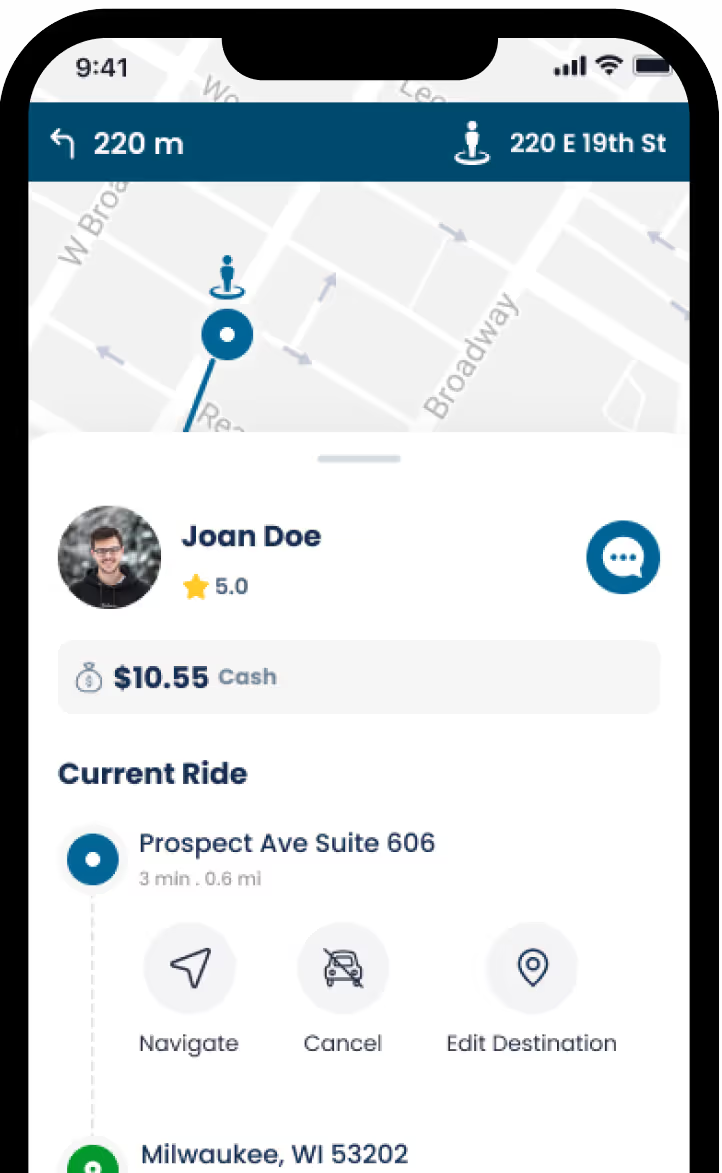
Real-time GPS driver tracking — the live map showing the driver's position, route to pickup, and continuously updating ETA is the single most effective anxiety-reduction feature in ride-hailing. It transforms a passive, uncertain wait into an engaged, informed one.
Driver and vehicle confirmation details — once matched, the passenger sees the driver's name, photo, star rating, vehicle make, model, color, and license plate number. This combination of identity verification and vehicle description means the passenger knows exactly who to look for and can approach confidently.
In-app messaging and calling — direct, in-app communication between passenger and driver without sharing personal phone numbers allows for coordination of exact pickup points, last-minute changes, or simple confirmation that both parties are in the right place.
Arrival notification — a push notification when the driver is one minute away prompts the passenger to head to the pickup point, reducing driver idle time at the curb and improving the pickup experience for both parties.
OTP-based ride start confirmation — some markets have adopted OTP verification at pickup, where the driver enters a passenger-provided code to confirm the correct person has boarded before the trip begins. This security layer reduces fraud and mismatches in high-density pickup environments.
Once the passenger is in the vehicle, the experience shifts from digital to physical — and the platform's role transitions from booking facilitator to safety guardian and journey monitor.
Live trip tracking shared with contacts — the ability to share a real-time trip link with a trusted contact is particularly valued by passengers traveling alone, especially at night. This feature is specifically important for female passengers, who represent 59% of users in multiple markets and maintain higher trip frequency than male passengers — meaning their experience priorities disproportionately influence overall platform satisfaction.
In-trip route transparency — the passenger-facing map showing the current route and estimated arrival time means passengers can verify that the driver is following the expected path. Any significant deviation triggers concern; a visible map prevents that concern from arising in the first place.
SOS and emergency features — in-app emergency alert buttons, connected to both the operator's dispatch portal and local emergency services, provide passengers with an immediate safety mechanism without requiring them to unlock a different app or make a visible call. This feature has a significant effect on perceived platform safety — particularly for demographics where safety is the primary reason for platform selection.
Ride comfort baselines — research shows ride comfort scores at 80.3/100 among passengers globally, but comfort functions as a baseline expectation rather than a delight factor. Meeting the baseline (clean vehicle, respectful driver, smooth ride) prevents dissatisfaction. Exceeding it — exceptional driver courtesy, proactive communication, vehicle extras like phone chargers — creates the kind of memorable experience that drives both strong ratings and organic referrals.
In-trip upsell opportunities — well-timed, non-intrusive notifications during the ride can prompt passengers to schedule their return trip, apply a promotion for their next booking, or explore premium vehicle options for future rides. These touchpoints work precisely because the passenger is already engaged with the platform and in a positive service moment.
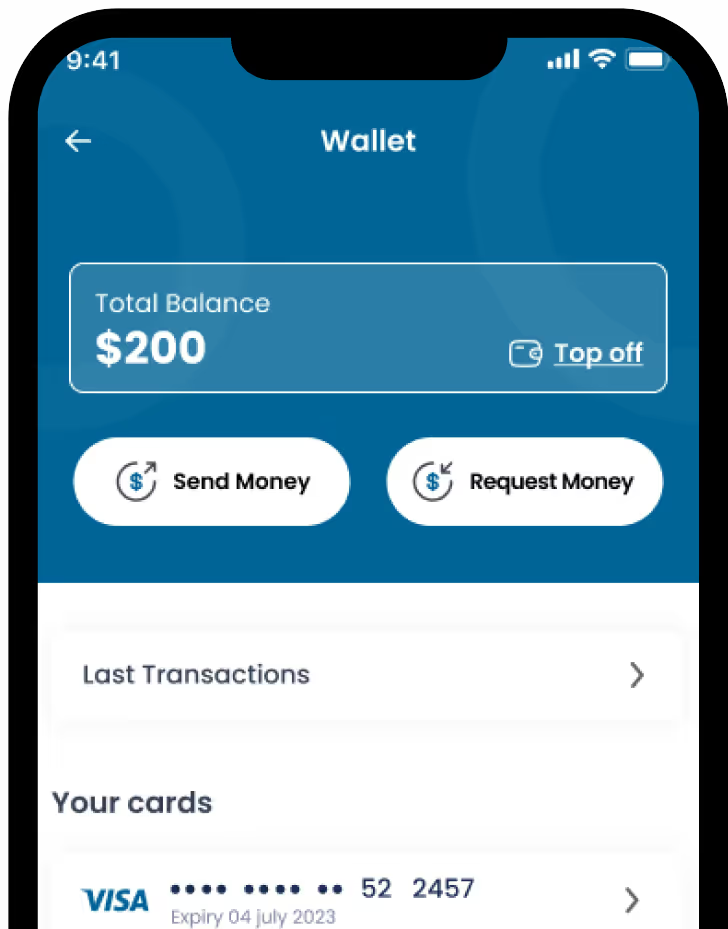
Payment is the last functional interaction of every ride, and it carries disproportionate weight in the passenger's overall impression of the experience. A seamless payment experience is essential for delivering convenience and reducing friction at the end of a ride.
Automatic payment — the most frictionless payment experience is no payment experience at all: the fare is charged automatically to the saved payment method, the passenger receives a receipt, and they can exit the vehicle without any transaction-related interaction. Every manual payment step — entering a card, entering a PIN, waiting for a terminal — is friction that degrades the trip-end experience.
Multiple payment methods — credit cards, digital wallets (Apple Pay, Google Pay), bank transfers, in-app wallet, and cash (in appropriate markets) all serve different passenger segments. Supporting multiple methods ensures no passenger is excluded by their payment preference. RideWyze supports multiple payment gateway integrations, including digital wallet connectivity and cash-based payment for markets where digital payment adoption is still developing.
Transparent fare breakdown — the post-trip receipt should clearly show base fare, any surcharges, tip (if applicable), and total paid. Surprises on the receipt — fees the passenger did not expect — are among the fastest destroyers of post-ride satisfaction. Passengers who feel the final charge was unfair rarely return.
Tipping capability — the in-app tip option is a feature that benefits all parties. It gives satisfied passengers a mechanism to reward exceptional service, increases driver earnings, and signals to drivers that performance quality is recognized and rewarded by the platform. The tip feature encourages better behavior and strengthens the rider-driver relationship through positive reinforcement.
The post-ride stage is where the platform learns — or fails to learn. Ratings and reviews provide valuable insights into passenger and driver experiences while promoting accountability among all participants. A transparent review system encourages professional behavior, helps identify service issues, and enables continuous improvement.
The two-way rating system — passengers rate drivers, and drivers rate passengers. This mutual accountability system is one of ride-hailing's most important quality control mechanisms. Consistently low driver ratings lead to platform review and corrective action; consistently poor passenger behavior ratings protect drivers from repeat problematic passengers.
Simple, fast rating UI — the post-ride rating prompt should appear immediately after trip completion, require minimal taps, and offer optional commentary for passengers who want to provide detail. A rating process that feels cumbersome will be skipped — and skipped ratings mean less data for quality improvement.
Structured feedback categories — beyond a star rating, structured prompts ("Was the vehicle clean?", "Did the driver follow the navigation?", "Rate the pickup experience") give operators specific, actionable data by service dimension rather than a single aggregated score.
Immediate response to negative feedback — when a passenger leaves a low rating, an automated system should trigger a response protocol: an in-app message acknowledging the experience, an offer of a discount or credit on the next ride, and an internal alert to the operator's quality team for investigation. Research shows that empathetic responses to complaints can convert frustrated passengers into loyal ones — turning a service failure into a loyalty-building moment.
Post-ride re-engagement — the moment after trip completion is the highest-engagement window for prompting the next booking. A well-timed push notification — "Book your ride home now" or "Schedule tomorrow's commute" — catches the passenger while the app is front-of-mind and the current experience is fresh.
Retention improves when riders feel understood. Using trip history, preferences, and saved locations to tailor offers and recommendations makes the platform feel personal rather than generic — and personal platforms earn loyalty that generic ones never can.
Practical personalization applications across the passenger journey include:
At booking: Showing the passenger's most frequent destinations as one-tap shortcuts. Displaying the vehicle type they used most recently as the default selection. Remembering their preferred payment method.
Pre-ride: Recognizing that a passenger regularly books from a specific location at 7:30 AM and proactively suggesting a scheduled booking the night before.
Post-ride: If a passenger always takes the same commute corridor, offering them a weekly commuter pass that saves them money and pre-commits their rides for the week.
Loyalty tiers: As passengers complete more rides, unlocking incremental benefits — priority matching, surge price caps, free scheduled bookings — that make staying on the platform more valuable than switching. Implementing loyalty programs can increase rider retention by up to 25%.
The deeper the personalization layer, the higher the switching cost — not because the platform locks passengers in, but because it knows them better than any alternative they could move to.
The most sophisticated aspect of a well-designed passenger journey is that it is self-improving. Every rating, every comment, and every complaint entered through the post-ride feedback mechanism feeds back into the platform's intelligence:
RideWyze's analytics dashboard surfaces this feedback data in aggregated, actionable form — allowing operators to identify service quality trends, spot emerging issues before they become systemic, and track improvement over time. This closes the loop between passenger experience and operational decision-making in a way that purely reactive management never achieves.
Every feature described in this guide is either built into RideWyze's platform or configurable through its customization and integration layer:
For operators who want to build a ride-hailing service that passengers actively prefer — not just use — RideWyze provides the platform foundation to deliver a consistently excellent journey at every stage.
Start your 30-day free trial at ridewyze.com — no credit card required, full platform access from day one.
The passenger journey in ride-hailing has six key stages: discovery and onboarding, ride booking, the pre-ride wait, the ride itself, payment and trip completion, and post-ride feedback. Each stage presents specific expectations and friction points that determine whether a passenger becomes a loyal repeat user or churns to a competitor.
Research consistently identifies ease of use as the factor carrying the heaviest importance weight in passenger satisfaction — with an importance weight of 0.448 in key satisfaction studies. Passengers want an app that is frictionless: booking a ride should feel as natural as sending a text. Transparency in pricing, real-time tracking, and fast confirmation all contribute to this perception of ease.
The primary drivers of passenger churn are hidden fees or unclear pricing (cited by 45% of switchers), long or uncertain wait times, poor communication during the pre-ride stage, and unresolved post-ride complaints. Operators prevent churn by displaying upfront pricing, providing real-time driver tracking, enabling in-app communication, and responding quickly and empathetically to negative feedback.
Real-time GPS tracking eliminates the single biggest source of pre-ride anxiety — uncertainty about when the driver will arrive. Passengers who can see their driver approaching on a live map feel in control of the wait and are significantly less likely to cancel. Research shows passengers psychologically experience wait time approximately 30% more negatively than in-vehicle time, making visible ETA a critical anxiety-reduction feature.
Post-ride ratings create a continuous quality feedback loop. Low driver ratings trigger platform review and corrective action. Structured feedback categories identify specific service dimensions — cleanliness, navigation, courtesy — where improvement is needed. Aggregated rating data surfaces trends that allow operators to make evidence-based decisions about driver training, vehicle standards, and service policies.
Yes. RideWyze's platform supports loyalty features including promotional codes, referral programs, and in-app reward configurations that operators can use to build tiered loyalty systems. Implementing loyalty programs can increase rider retention by up to 25%, and RideWyze gives operators the tools to configure and track these programs from the operator dashboard.
Ready to elevate your ride-hailing business? RideWyze has the tools and expertise to help you succeed. Contact us for a personalized demo today!

Create a free account and get full access to all features for 30 days.No credit card needed. Trusted by over 4,000 Clients.


from 200+ reviews

Start your 30-day free trial.