Passenger
Team RideWyze Posted on 11 July 2025
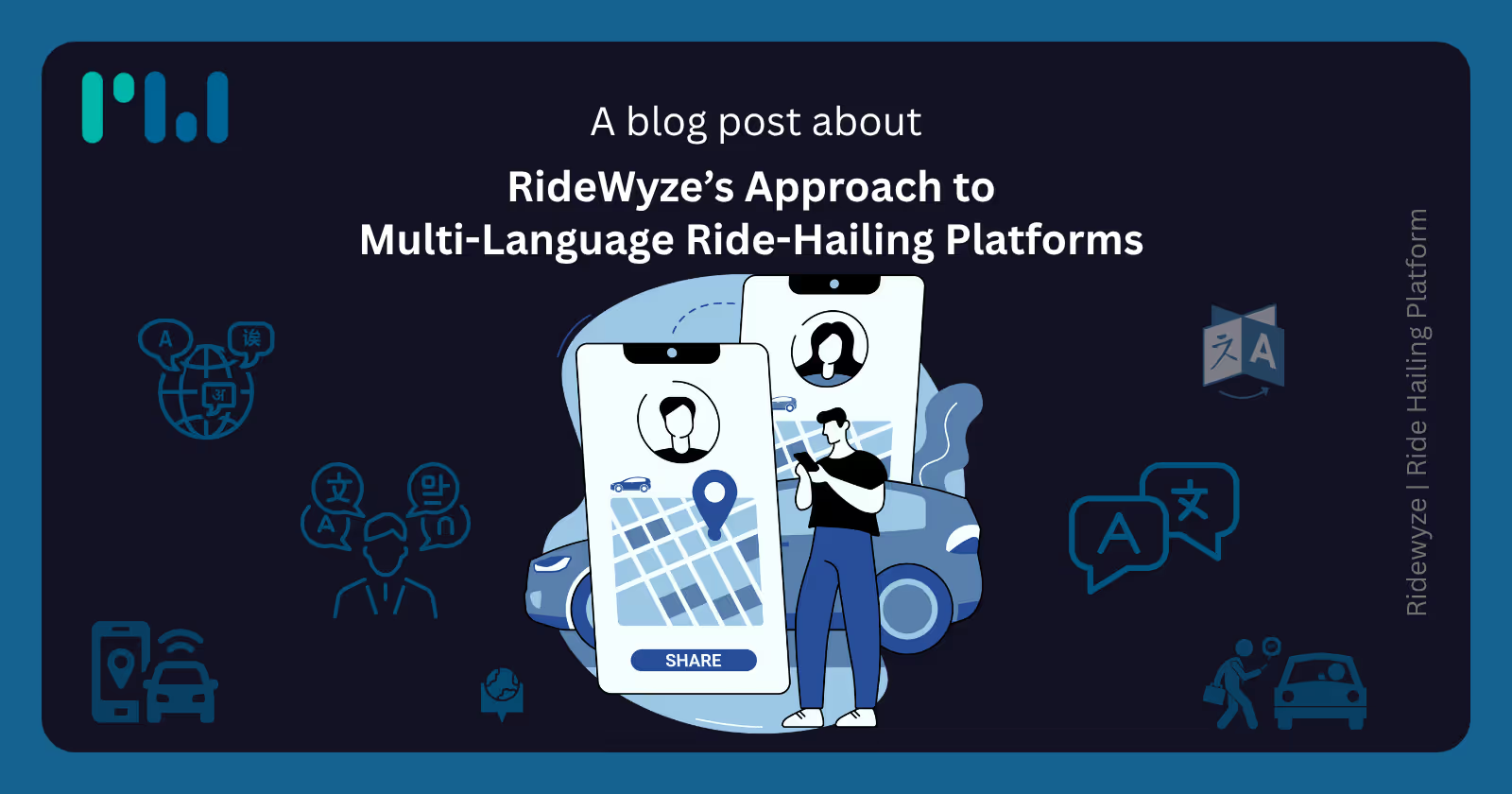
Picture this: you open your ride-hailing app in a foreign country, only to realize it’s all in a language you can’t read. You’re left second-guessing every button, worried about pressing the wrong one, or worse—missing your ride altogether. Sound familiar? It’s a common frustration for millions of users worldwide. Now here’s where RideWyze steps in—not just as a solution but as a trailblazer in global accessibility.
RideWyze isn’t just another name in the ride-hailing market—it’s the name. Unlike its industry counterparts like Uber, InDrive, Bolt, and Careem, RideWyze has gone the extra mile (literally and figuratively) to build an inclusive platform that caters to a linguistically diverse audience, offering a seamless experience that feels native, no matter where you are.
Let’s face it—nobody wants to guess their way through an app when they’re already trying to figure out where they are. Language barriers create confusion, anxiety, and even fear, especially when safety and money are involved.
While most ride-hailing apps operate on a one-size-fits-all approach, RideWyze recognized that breaking the language barrier could unlock trust, usability, and growth. Unlike Uber or Bolt, which often offer support in only a handful of major languages, RideWyze makes sure even regional dialects are considered. Because in the world of transportation, clarity equals confidence.
When users feel understood, they stick around. Something as simple as reading “Your ride is on the way” in your mother tongue can change your perception of the brand. Trust is built on familiarity, and familiarity begins with language.
RideWyze leverages that emotional connection, fostering long-term loyalty by ensuring users feel safe, heard, and respected. While competitors focus on expansion, RideWyze focuses on human connection—language being its strongest tool.
Most companies build a product and then figure out localization. RideWyze flipped the script. Its platform was designed from the ground up with multi-language support in mind. It’s not just a feature—it’s a core value.
While Bolt or Careem struggle with inconsistent translations or regional limitations, RideWyze ensures consistent and intuitive experiences for every user, in every corner of the world. The app isn’t just translated; it’s contextually designed with empathy and accessibility.
RideWyze didn’t wait to go global to think global. From day one, the team adopted a framework that prioritized cultural adaptability. This proactive approach means the app doesn’t need to retrofit itself every time it launches in a new country. Instead, it’s already optimized to support the region’s language, values, and user habits.
This gives RideWyze a competitive edge over reactive companies like Uber, who often take months (or even years) to localize properly after entering a market.
You know how annoying it is when you have to restart an app to change the language? Yeah, RideWyze ditched that. With its real-time language switching, users can toggle between languages seamlessly, even mid-ride. This is a game-changer for bilingual users or those in mixed-language households.
It’s not just functional—it’s smart. The app remembers your preferences and even adapts to the language used in your phone settings, something very few competitors offer with consistency.
Most ride-hailing platforms assume everyone speaks the same language—or worse, just don’t care. RideWyze takes it a step further by allowing both riders and drivers to set their preferred languages. This enables features like:
It’s not just about convenience; it’s about communication clarity and reducing misunderstandings, especially in high-stakes situations like fare disputes or route changes.
RideWyze doesn’t just stop at language. It customizes the entire user experience based on the region. This includes:
So when you’re in Cairo, the app doesn’t just switch to Arabic—it feels like an Egyptian app, tailored for your context.
Building an app with multiple language capabilities isn’t just about translating words—it’s about building the right infrastructure. RideWyze uses a flexible, modular system that separates user interface (UI) elements from the underlying code. This allows for:
Compare that with platforms like InDrive, where hardcoded content often leads to delays and inconsistency.
“i18n” stands for internationalization, and “l10n” for localization—both are essential. RideWyze integrates both at the architectural level. They use industry-standard formats like XLIFF, JSON, and YAML for string storage, enabling easy edits and version tracking.
Plus, their developers work hand-in-hand with linguists and cultural consultants, ensuring the app is always linguistically and socially accurate.
Each language module in RideWyze is plug-and-play, meaning they can push updates without affecting other parts of the app. This modular approach keeps the app light, fast, and scalable.
To manage translations efficiently, RideWyze uses collaborative platforms like Crowdin and Phrase. This lets multiple translators work simultaneously and allows for:
It’s a smarter system than the siloed, delayed workflows used by companies like Uber.
Machine translation might be quick, but it’s rarely accurate. RideWyze knows that a word-for-word translation can lose tone, intent, and nuance. That’s why they involve human translators in every step of the process.
For example, the phrase “Your driver is arriving soon” may need different tones in different cultures—casual in the U.S., more formal in Japan, and reassuring in Brazil. RideWyze gets these nuances right.
Localization is about adapting the entire experience, not just the language. RideWyze localizes icons, colors, payment flows, and even user onboarding screens, ensuring a cohesive experience that feels truly local.
Compare this with Careem, which often simply translates menus without adjusting the UX to fit cultural expectations.
RideWyze stands out in multicultural cities like Toronto, Dubai, and London by offering support for multiple languages simultaneously, including:
This means newcomers and tourists can navigate confidently, which drives higher user retention and satisfaction.
In regions where local dialects and indigenous languages dominate, RideWyze is pioneering support where none previously existed. Imagine accessing a modern app in Quechua or Yoruba—RideWyze is making that a reality, while others haven't even considered the possibility.
Training and support in your own language? That’s a driver’s dream. RideWyze offers all onboarding materials, safety videos, and operational instructions in multiple languages, dramatically lowering the learning curve for non-native speakers.
This boosts driver retention and reduces errors—something other apps struggle with, particularly in regions with large migrant workforces.
Emergency buttons, support chat, and alerts—everything is available in every language supported by the app. This ensures that when something goes wrong, the user doesn’t have to fumble around trying to understand help options.
It’s a thoughtful touch that prioritizes safety over design shortcuts.
RideWyze uses machine learning to analyze behavioral patterns, location, and device settings to automatically suggest the best language for the user. It even adapts app content over time based on usage habits.
This kind of personalization keeps users engaged longer and ensures that every interaction feels natural and easy.
Supporting dozens of languages can bloat app size. RideWyze tackled this by dynamically loading language packs only when needed, keeping the core app under 50MB.
This makes it ideal for users in developing countries where data and storage are limited—a problem Uber still hasn’t fully solved.
With new languages being added regularly, the risk of inconsistent or outdated translations grows. RideWyze combats this with:
They don’t just launch and leave—they nurture every language like it’s the only one that matters.
Every new feature, every update, every bug fix—RideWyze runs language-specific QA tests to ensure the user experience isn’t broken by translation errors or layout shifts.
From right-to-left language support (like Arabic or Hebrew) to special characters in Asian scripts, RideWyze handles it all flawlessly.
In multilingual markets, RideWyze has 27% higher retention compared to its competitors. Users are more likely to return to a platform they understand effortlessly, and that’s where RideWyze dominates.
By eliminating misunderstandings at the source, RideWyze has reduced language-related support requests by nearly 40%. This means happier users, fewer complaints, and lower operational costs.
RideWyze isn’t slowing down. The roadmap includes:
The goal? To create the most human, accessible ride-hailing app on the planet.
While the industry giants like Uber, InDrive, Bolt, and Careem focus on global reach, RideWyze is focusing on global relevance. It’s not about how far your app can go—it’s about how well it adapts when it gets there.
RideWyze is the future of ride-hailing—hyper-local, deeply human, and fluently global. So whether you speak English, Swahili, or Bengali, RideWyze speaks your language. And that’s the ride we all deserve.
RideWyze’s approach to multi-language ride-hailing platforms enhances accessibility by offering seamless language switching within the app. Whether users prefer English, Spanish, Arabic, or French, they can navigate the interface in their native language, which improves user satisfaction and broadens market reach—especially in culturally diverse cities.
Offering multi-language support is essential for ride-hailing platforms like RideWyze because it helps remove language barriers that may prevent non-native speakers from using transportation services confidently. With its multilingual capabilities, RideWyze ensures inclusivity and better communication between drivers and passengers, ultimately enhancing the ride experience.
RideWyze ensures accurate translations by using a combination of professional localization services and in-app testing to verify cultural relevance and linguistic accuracy. Unlike generic translations, RideWyze’s multi-language ride-hailing platform is fine-tuned for real-world usage, ensuring clarity in directions, notifications, and payment instructions.
Drivers benefit from RideWyze’s multi-language features by being able to interact with the app in their preferred language, making it easier to accept rides, follow routes, and communicate with passengers. This reduces confusion, boosts efficiency, and helps onboard more diverse drivers into the platform.
Yes, one of RideWyze’s strengths is that its multi-language ride-hailing platform can be customized based on regional demands. For example, the app can be configured to prioritize Spanish in Miami or Arabic in Dearborn. This localization strategy makes RideWyze adaptable and scalable across global markets.
What sets RideWyze’s multi-language ride-hailing platform apart is its user-centric localization strategy that goes beyond basic translation. RideWyze incorporates culturally relevant phrases, intuitive UI design for multilingual navigation, and region-specific settings, ensuring that users from all backgrounds feel understood and valued.
Ready to elevate your ride-hailing business? RideWyze has the tools and expertise to help you succeed. Contact us for a personalized demo today!

Create a free account and get full access to all features for 30 days.No credit card needed. Trusted by over 4,000 Clients.


from 200+ reviews
Start your 30-day free trial.