Passenger

Team RideWyze Posted on 9 September 2025
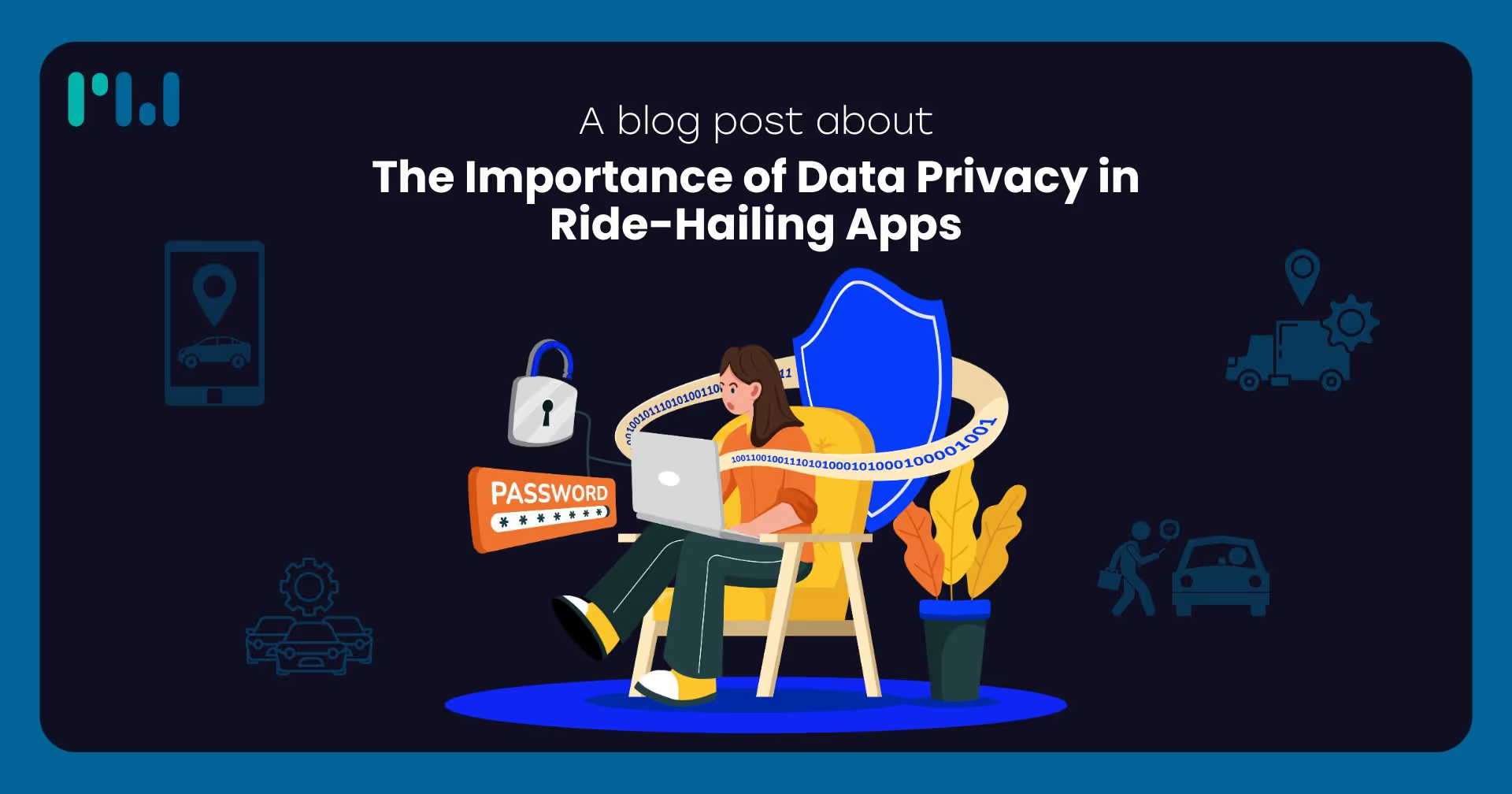
In the last decade, ride-hailing services like Uber, Lyft, and other on-demand transport platforms have fundamentally changed how we navigate cities and towns worldwide. With just a few taps on a smartphone, you can summon a ride, avoid parking hassles, and get to your destination quickly and affordably. But behind this remarkable convenience lies a complex ecosystem that depends on the continuous collection, processing, and storage of vast amounts of sensitive user data.
This data, while enabling seamless service, also poses significant privacy risks. As users increasingly question how their information is collected, shared, and protected, the topic of data privacy in ride-hailing apps has moved from the sidelines to center stage. In this article, we will explore the vast ride-hailing data collection scope, the intricate balance of location privacy vs. service quality trade-off, and the lessons learned from high-profile incidents like the Uber data breach 2016 impact. We will also dive into how users can exercise control over ride-hailing data, and the promising future of privacy-enhancing technologies in ride-sharing.
At the core, every ride-hailing app requires a user to provide some personal identifiers: your name, email, phone number, and payment method. These are the bare minimum for account creation and billing. However, once you begin requesting rides, the scope of data collection expands dramatically.
Location data is the most sensitive and voluminous piece collected. Your device’s GPS provides a real-time stream of precise coordinates—not only when you book a ride, but during your trip, and often even after it ends. Apps log your entire trip history including pickup points, drop-offs, routes taken, trip fares, and timestamps.
In addition, the app collects device metadata, such as your operating system, app version, IP address, and even network diagnostics. Some platforms also collect social data — Facebook friend lists, profile photos, or other linked accounts — which can create an even richer profile.
Studies have shown that on average, each ride involves the collection of 5 to 29 different data fields, depending on the platform and its features. For example, a 489,000-ride dataset from Manhattan highlights just how massive and detailed these records can be.
This massive data collection enables ride-hailing companies to refine their services, optimize routes, and offer personalized promotions. But it also paints a detailed digital portrait of your movements, habits, and even preferences—raising serious ride-sharing data privacy issues.
At the heart of this data dilemma lies the question: how much location precision is necessary to deliver a smooth, timely ride, and when does it cross the line into intrusive surveillance?
The essence of ride-hailing depends on accurate, real-time location tracking. Your app uses GPS data to identify your location, calculate Estimated Time of Arrival (ETA), and match you with nearby drivers. Without precise location, the experience suffers — longer wait times, incorrect pickups, and inefficient routing.
However, enhanced location tracking means platforms hold detailed logs of your whereabouts, potentially exposing you to tracking by third parties, data leaks, or misuse.
Studies on location privacy vs. service quality trade-offs reveal interesting insights. When users enable strong location privacy settings—such as real-time location masking or cloaking—average wait times increase by 7% to 22%, depending on how much the location is blurred. Vehicle miles traveled (VMT) rise by 2% to 9%, contributing to higher emissions and operational costs.
Yet, in most cases, fare calculations remain accurate, with less than 10% error in 95% of rides and less than 100 meters of excess pickup distance in 80% of rides. This suggests that privacy protections can be implemented with minimal impact on the user experience if designed thoughtfully.
Balancing user privacy with service efficiency remains one of the biggest technical and ethical challenges for the ride-hailing industry.
The reality of privacy risks hit the public consciousness with a splash in 2016 when Uber suffered one of the largest breaches in ride-hailing history.
Hackers infiltrated Uber’s systems and stole data on 57 million users and drivers, including names, email addresses, and phone numbers. Worse, Uber initially concealed the breach, paying hackers $100,000 to delete the stolen data and keep the incident quiet.
When the breach became public knowledge, Uber faced enormous backlash and legal consequences, resulting in $148 million paid to settle lawsuits in the United States alone, along with a £385,000 fine from the UK Information Commissioner’s Office.
The incident starkly exposed how vulnerable the massive pools of ride-hailing data are and sparked intense calls for stronger safeguards. It also raised awareness about GDPR compliance for Uber & Lyft, pushing these platforms to overhaul their data governance policies and invest in encryption, access controls, and breach detection.
While platforms are responsible for securing data, users too want and deserve control over their personal information. However, many feel powerless once they click “I agree” during app installation.
In regulated regions like the EU and California, laws require transparency and consent, but adoption varies globally. Users can take several steps to regain some control:
Despite these options, about 45% of users feel they have “no control” over their data after initial consent, highlighting a gap between policy and perception.
Giving users control isn’t just about compliance; it builds trust and user loyalty. Platforms that empower users with clear data rights and simple settings can differentiate themselves in a competitive market.
Innovation is rising to meet these challenges. New privacy-enhancing technologies in ride-sharing aim to secure user data while maintaining seamless service.
Instead of storing exact locations and times, data is aggregated and anonymized to remove identifiers. This allows platforms to analyze trends without exposing individual users.
These algorithms pair drivers and riders while minimizing the exposure of personal data. They may rely on cryptographic techniques to keep identities and routes confidential.
This cutting-edge method allows fare determination without revealing trip details to the service provider. The driver and rider prove the fare independently without sharing their exact locations.
This method injects controlled randomness into datasets used for analytics or reporting. It prevents any individual ride from being re-identified in aggregated data.
Encrypting all data transmitted between users and servers prevents interception by hackers or unauthorized insiders. It’s the same technology that secures banking and messaging apps.
Masking obfuscates your true location dynamically during a ride request, increasing anonymity but keeping accuracy high enough for pickups.
Discussions about data privacy often focus on passengers, but driver privacy in on-demand transport is equally important.
Emerging standards promote driver-side data minimization, ensuring only necessary data is collected during active trips, and allowing drivers more control over their own information.
The European Union’s General Data Protection Regulation (GDPR) is among the strictest laws worldwide, enforcing transparency, consent, data minimization, and the right to be forgotten. Non-compliance can lead to fines up to €20 million or 4% of global turnover.
California’s Consumer Privacy Rights Act (CPRA) extends protections to sensitive personal information, including geolocation, with fines ranging from $2,500 to $7,500 per violation—potentially costing ride-hailing companies over a billion dollars annually if ignored.
With millions of rides per day, ensuring compliance at scale requires robust data governance frameworks and continuous auditing.
In 2022, a third-party vendor mishandled Lyft driver license images, exposing over 1,200 records. While no rider data was compromised, the incident illustrated risks in vendor management.
Phishing attacks, unencrypted data storage, and lax internal controls continue to expose ride-hailing platforms to breaches, emphasizing the need for ongoing vigilance.
Despite increasing concerns, many users lack awareness of privacy risks or how to protect themselves.
This platform incorporates location masking, no long-term data storage, and privacy-preserving fare calculations. It adds minimal latency to the user experience, proving privacy and usability can coexist.
Other startups are exploring decentralized identity systems and blockchain-based models to give users ownership over their data.
As ride-hailing integrates AI for predictive analytics, ethical data handling becomes critical.
Companies will need to embrace passenger data protection in mobility apps as a strategic differentiator—not just a legal checkbox.
The challenge of data privacy in ride-hailing apps reflects broader societal concerns about digital surveillance, consent, and security. With roughly 29 different data points collected per ride and 76% of that data visible to others, privacy cannot be an afterthought.
By investing in cutting-edge privacy-enhancing technologies, adhering to evolving regulations like GDPR and CPRA, and empowering users with control and transparency, ride-hailing platforms can build trust and sustainability in a competitive market.
Ultimately, safeguarding user and driver data is not just a regulatory necessity but a critical component of the future of urban mobility. The journey towards truly private and secure ride-hailing services is underway—and it’s one we all share.
Data privacy in ride-hailing apps refers to how companies like Uber or Lyft handle users' personal and location information. It matters because these platforms collect highly sensitive data, such as your real-time whereabouts, payment info, and trip history. Without strong protections, this data can be misused or exposed during breaches.
The ride-hailing data collection scope is broad—apps gather location data, contact details, payment credentials, device identifiers, and even communication logs between drivers and riders. This helps improve service but also increases privacy risks if not properly managed.
Yes, there's a trade-off between location privacy vs. service quality. If you disable location access, the app may struggle to offer accurate pickup points, real-time ETAs, or driver routing. However, some privacy-friendly apps now offer features like manual location input or temporary sharing to balance privacy with usability.
The Uber data breach 2016 impact was significant—personal info of over 57 million users and drivers was exposed. Uber initially concealed the breach, leading to legal repercussions and a major trust issue. It underscored the need for transparency and stronger data security in ride-sharing platforms.
User control over ride-hailing data is improving with newer privacy regulations. Many apps now allow you to view, delete, or restrict access to your data. Features like GDPR-based data requests and customizable privacy settings empower users to protect their information more effectively.
Privacy-enhancing technologies in ride-sharing include anonymized trip data, end-to-end encryption, and differential privacy techniques. Some platforms also use privacy-preserving matching algorithms and real-time location masking to reduce the exposure of sensitive user data during rides.
Ready to elevate your ride-hailing business? RideWyze has the tools and expertise to help you succeed. Contact us for a personalized demo today!

Create a free account and get full access to all features for 30 days.No credit card needed. Trusted by over 4,000 Clients.


from 200+ reviews

Start your 30-day free trial.